The E-MTB Experiment — Part 3
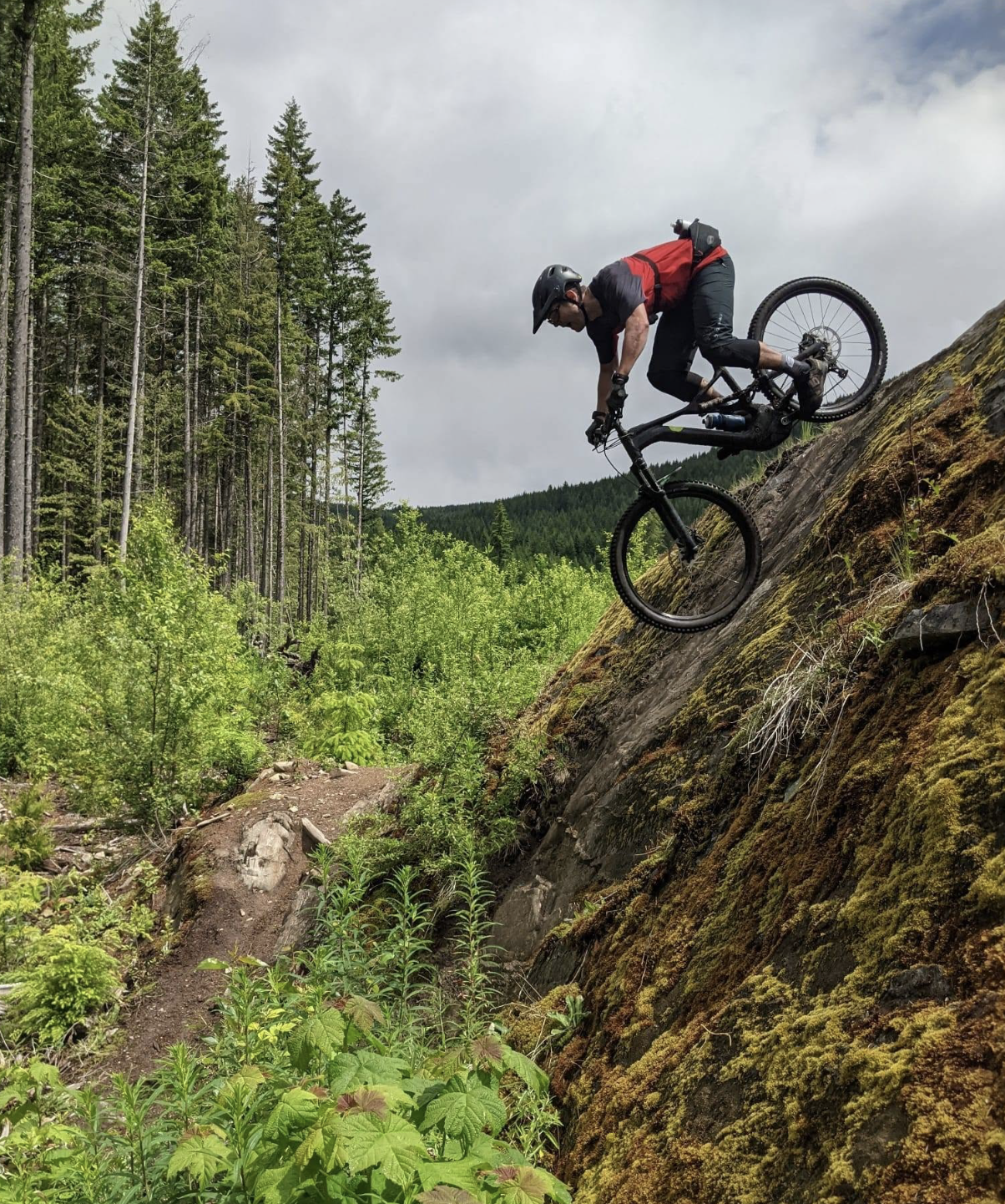
Does riding an electric mountain bike mean you need less strength training? Absolutely not. E-MTB riders still need strength, power and muscular endurance to control their bikes, handle technical terrain and manage fatigue. In fact, the additional descending opportunities and greater bike weight can make physical preparation particularly important.
There's a common assumption that because an e-bike has a motor, the rider doesn't need to be as strong.
That's a mistake.
An e-MTB reduces the effort required to propel the bike, but it doesn't eliminate the physical demands of mountain biking.
In fact, there are several reasons why strength training deserves particular attention if you're riding an electric mountain bike.
You're likely accumulating more descending, controlling a heavier bike and exposing your body to more technical terrain.
Your legs, upper body and trunk still have to manage those demands, regardless of how you got to the top.
There's also an interesting opportunity.
If you're not devoting quite so much of your training and recovery resources to aerobic development, you may have more available to invest in getting stronger.
And there's one strength quality that many e-MTB riders overlook.
Torque production.
Before you dismiss torque as something that only matters for short sprints or steep technical climbs, think again.
Your ability to produce torque matters during sustained climbing, too.
Let's look at what your body actually needs from you when you're riding an e-MTB, and how strength training can help.
1. Why E-MTB Riders Need Strength Training
One of the biggest attractions of an electric mountain bike is that you can get more riding into the same amount of time.
More laps. More descending. More technical terrain.
For many riders, that's exactly why they bought one.
But while the motor helps you get back to the top, it doesn't do the descending for you.
Every additional descent means more time absorbing impacts, maintaining your riding position, managing braking forces and controlling the bike over unpredictable terrain.
And that work adds up.
Descending requires strength and muscular endurance
Think about what your legs do during a descent.
They're not simply holding you upright.
Your quads, glutes, hamstrings and calves are constantly adjusting to changes in terrain. They're absorbing impacts, controlling your position over the bike and producing force when you need to push into the ground or unweight the wheels.
Much of that work involves eccentric muscle actions, where muscles produce force while lengthening, and isometric contractions, where they generate force without much movement.
These contractions can become particularly demanding when repeated over long descents.
Now imagine doubling the amount of descending you're doing.
Your aerobic workload might not have doubled, but your legs are still accumulating considerably more physical work.
The motor makes getting to the top easier. It doesn't make the descent physically free.
Does a heavier e-MTB require more strength?
Modern full-power e-MTBs are generally heavier than comparable acoustic mountain bikes.
That additional mass affects how the bike responds when you accelerate, brake, change direction or move it around beneath you.
It doesn't mean every movement requires dramatically more strength. Geometry, suspension, weight distribution and riding technique all influence how a bike handles.
But there are situations where that extra mass becomes noticeable.
Lifting the front wheel over an obstacle. Changing direction quickly. Correcting your line when the bike gets deflected. Controlling the bike through successive compressions.
These are situations where strength, coordination and the ability to produce force quickly become valuable.
And when you're tired, those qualities become even more important.
2. Upper-Body Strength, Grip Endurance and Core Stability for E-MTB Riders
Mountain biking is often described as a leg-dominant sport.
But spend a few hours riding technical trails and you'll quickly appreciate how much work your upper body does.
Your arms aren't simply hanging onto the handlebars.
They're pushing, pulling, absorbing impacts and making constant adjustments to keep the bike underneath you.
Shoulder and upper-body strength
Your shoulders, chest, back and arms help you maintain control through braking zones, compressions, drops and technical terrain.
Sometimes you need to resist a force.
Sometimes you need to produce one.
And sometimes you need to react quickly to something you didn't anticipate.
This is why I include pushing and pulling exercises in strength programs for mountain bikers.
Rows, pull-ups, presses and push-up variations aren't there to build an impressive-looking upper body.
They're there to develop the physical capacity to control the bike.
Grip strength and endurance
Grip fatigue is another common limitation, particularly on long, rough descents.
Your hands and forearms are responsible for maintaining contact with the handlebars while also managing braking and steering.
Those demands aren't constant.
They're a combination of sustained gripping, repeated contractions and occasional high-force efforts.
Having greater maximal grip strength can reduce the relative effort required for a given gripping task.
But maximal strength alone isn't enough.
You also need the endurance to keep producing and regulating that force as fatigue accumulates.
That's why a good mountain bike strength program should consider both force production and fatigue resistance.
Why core strength matters on an e-MTB
Your trunk provides the connection between your upper and lower body.
When you're standing on the pedals, your legs are supporting and moving your body while your arms are controlling the handlebars.
Your trunk has to coordinate those forces.
If you can't maintain a stable, adaptable position between your rib cage and pelvis, controlling the bike becomes more difficult.
This doesn't mean riding around with your abs permanently braced.
It means having enough strength and control to maintain useful positions, transfer force and respond to changes in terrain.
In the gym, we develop that capacity through exercises such as deadbugs, carries, anti-rotation exercises, squats, hinges and single-leg movements.
Then we progressively challenge the ability to maintain control while producing more force.
The objective isn't simply to make individual muscles stronger. It's to make your whole body better at working together.
3. Torque Production: The Overlooked Strength Quality in Mountain Biking
Here's something I don't think gets enough attention in discussions about e-MTB fitness.
Your ability to produce torque matters, even when you've got a motor helping you.
Torque describes the rotational effect of a force.
When you're pedalling, you're applying force to the cranks to produce rotation.
The amount of torque you produce depends on how much force you apply and how effectively that force acts around the crank.
And torque is directly related to power.
Power = Torque × Angular Velocity
In cycling terms, angular velocity is related to cadence.
This means you can produce the same power using different combinations of torque and cadence.
And that's where things get interesting.
Why low-cadence climbing requires more torque
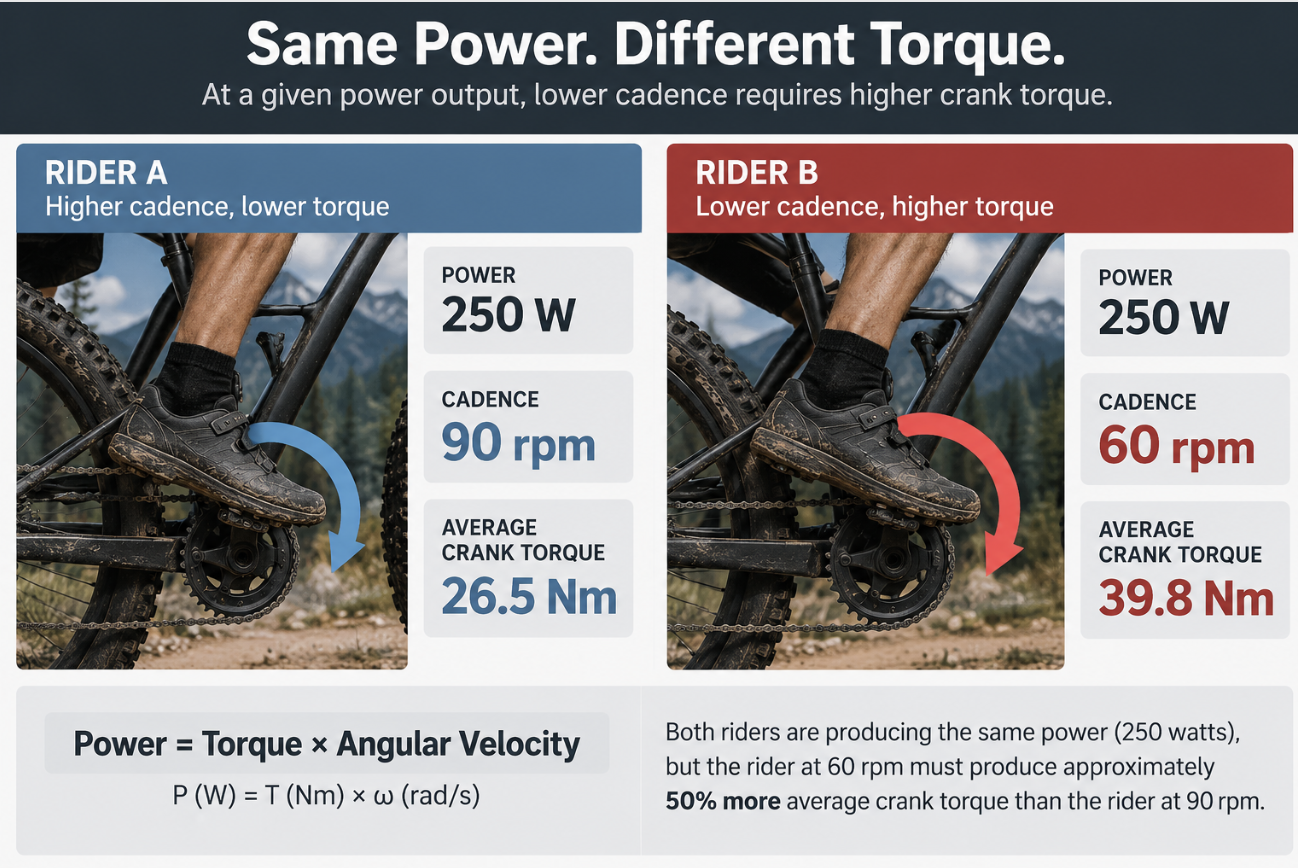
Imagine two riders producing 250 watts.
One is pedalling at 90 rpm.
The other is pedalling at 60 rpm.
Both are producing exactly the same power.
But the rider at 60 rpm must produce approximately 50% more average crank torque.
| Measurement | Rider A | Rider B |
|---|---:|---:|
| Rider power | 250 W | 250 W |
| Cadence | 90 rpm | 60 rpm |
| Average crank torque | 26.5 Nm | 39.8 Nm |
Same power.
Very different torque demands.
And that's important because mountain biking doesn't always allow you to pedal at your preferred cadence.
Steep gradients, technical obstacles, traction limitations and sudden changes in speed can force you into situations where you need to produce relatively high torque at low cadence.
Why torque matters for sustained climbing, not just sprinting
When people think about high-force pedalling, they often imagine explosive accelerations or short, punchy climbs.
Those certainly require torque.
But consider a sustained climb where you're pedalling at 60–70 rpm for 30 minutes.
You're repeatedly producing higher torque per pedal stroke than you would at a higher cadence for the same power output.
That creates a muscular demand that needs to be sustained over thousands of contractions.
This is where we need to distinguish between two related qualities.
Torque production capacity is your ability to generate rotational force.
Torque endurance is your ability to repeatedly produce the required torque without an unacceptable decline in performance.
A rider might be capable of producing enormous torque for a few pedal strokes but struggle to sustain moderate-to-high torque over a long climb.
Another rider might have excellent aerobic fitness but lack the force-producing capacity to deal comfortably with steep, low-cadence efforts.
These are different limitations.
And they don't necessarily respond to exactly the same training.
Doesn't the e-MTB motor provide the torque?
Partially, yes.
The motor contributes torque to the drivetrain, reducing the amount the rider needs to produce for a given total output.
That's the whole point of pedal assistance.
But how much assistance you receive depends on the motor system, assistance mode, cadence and how you're riding.
In lower assistance modes, or when you're deliberately using the e-MTB for training, your own torque contribution can still be substantial.
And even with plenty of assistance, you need to control your pedalling input to manage traction and negotiate technical terrain.
It's important to distinguish between the total torque delivered by the bike and the torque produced by the rider.
A powerful motor can make a steep climb possible with relatively little rider effort.
That doesn't mean the rider has developed the strength or muscular endurance to produce that torque independently.
Motor torque and rider torque aren't the same thing.
This becomes especially relevant if you ride both acoustic and electric mountain bikes.
Your e-MTB can help you accumulate riding volume, but it won't automatically maintain every physical quality required for unassisted climbing.
Those qualities still need to be trained.
4. Can E-MTB Riding Help You Make Better Strength Gains?
So far, we've discussed why e-MTB riding can create substantial strength demands.
But there's another side to this that I find particularly interesting.
Riding an e-MTB might actually create an opportunity to make better progress with your strength training.
Here's why.
Balancing strength and endurance training
If you're an acoustic mountain biker trying to improve your performance, you're probably balancing several different training demands.
You need aerobic fitness to sustain long rides and climbs.
You need higher-intensity fitness for repeated hard efforts.
You need strength and power to control the bike and deal with technical terrain.
And you need enough recovery to adapt to all that training.
Unfortunately, you don't have unlimited time or recovery capacity.
Long endurance rides, hard intervals and demanding strength sessions all contribute to your overall training load.
When these demands aren't managed properly, progress can suffer.
This is particularly relevant during the riding season, when many mountain bikers struggle to maintain consistent strength training alongside their riding.
How motor assistance can free up recovery capacity
An e-MTB gives us another variable to manipulate.
By increasing assistance, we can reduce the rider's required contribution to propulsion.
That potentially allows us to enjoy a similar amount of trail riding while accumulating less cardiovascular and pedalling-related fatigue.
And if we manage the total riding load intelligently, that may free up resources for strength development.
Imagine two versions of your training week.
In the first, you're doing several demanding acoustic rides alongside two gym sessions.
By the time you get to the gym, your legs are already carrying substantial fatigue.
In the second, some of those rides are completed on an e-MTB at a deliberately lower intensity.
You're still riding, practising skills and enjoying the trails.
But you're arriving at your strength sessions fresher.
That could allow you to lift heavier, maintain better movement quality and make more consistent progress.
Over time, those differences may translate into better strength adaptations.
More riding doesn't always mean better recovery
There's a catch.
This only works if you're actually reducing your overall training demand.
If you use the motor to double your riding volume, add more technical descents and spend longer on the bike, you might end up accumulating just as much fatigue—or more.
That's not necessarily a bad thing.
But it changes the training equation.
The opportunity isn't simply that e-bikes are less tiring.
It's that assistance gives us another way to control training stress.
We can choose when to prioritize aerobic development, when to accumulate technical riding exposure and when to preserve recovery capacity for strength training.
That's a powerful tool when used deliberately.
And it's something I intend to explore as part of this e-MTB experiment.
5. What Strength Exercises Should E-MTB Riders Do?
The best strength training program for an e-MTB rider develops the physical qualities required for their riding, including maximal strength, muscular endurance, explosive force production and trunk control.
That doesn't mean abandoning endurance training and spending every available hour lifting weights.
It means identifying what you need to improve.
Maximal strength: Squats, deadlifts and split squats
Maximal strength is your ability to produce high levels of force.
It provides a foundation for demanding movements, torque production and bike control.
Squats, deadlifts, split squats and other progressive resistance exercises can help develop this capacity.
Increasing maximal strength can make a given submaximal force requirement represent a smaller percentage of your maximum capacity.
But how that translates into riding performance depends on several other factors.
Muscular endurance: Sustaining force as fatigue builds
Muscular endurance is your ability to sustain or repeatedly produce force over time.
This is particularly relevant to long descents, repeated impacts and sustained pedalling demands.
We can develop it through appropriate gym training and specific riding work.
And it's worth remembering that muscular endurance is task-specific.
Being able to perform 30 bodyweight squats doesn't automatically mean you can maintain high torque on a 40-minute climb.
The training needs to reflect the objective.
Explosive strength: Producing force quickly
Sometimes you don't have much time to produce force.
Think about lifting the front wheel over an unexpected obstacle or responding to a sudden compression.
Your ability to generate force quickly matters.
We can develop this through appropriately progressed explosive exercises, jumps, throws and other athletic movements.
The goal isn't simply to move heavy weights.
It's to develop the ability to express strength quickly when required.
Upper-body and core strength: Maintaining bike control
We also need the strength and endurance to maintain control through repeated technical demands.
That means developing pushing, pulling, carrying and trunk-control capabilities.
For riders accumulating substantial descending volume, this becomes particularly relevant.
Don't forget aerobic fitness
An e-MTB doesn't eliminate the benefits of having a well-developed aerobic system.
Aerobic fitness supports sustained exercise, recovery between hard efforts and your ability to tolerate training.
Even if you're primarily riding an e-bike, maintaining an appropriate aerobic foundation remains valuable.
The important question is how much aerobic development you need relative to your goals—and how that fits alongside your strength training.
6. How to Build an E-MTB Strength Training Program
Two e-MTB riders can have completely different physical limitations.
One might struggle with grip fatigue halfway down a long descent.
Another might have plenty of upper-body endurance but lack the leg strength to maintain control through repeated compressions.
A third might struggle to produce enough torque during steep, low-cadence climbing.
And another might simply be accumulating more riding fatigue than they can recover from.
Giving all four riders the same generic strength circuit doesn't make much sense.
The objective is to identify the limiting quality and train it deliberately.
That's the approach I take with the mountain bikers I coach.
We assess how they move, what they're capable of and where their performance starts to break down.
Then we build a program that addresses those limitations while accounting for their riding, available training time and recovery.
Because the best strength program isn't necessarily the hardest one.
It's the one that develops the qualities you actually need.
Frequently Asked Questions About E-MTB Strength Training
Do electric mountain bike riders need strength training?
Yes. Electric mountain bike riders still need strength to control the bike, absorb impacts, maintain riding positions and manage fatigue. Motor assistance reduces the effort required for propulsion but doesn't eliminate the physical demands of technical mountain biking.
Is riding an e-MTB easier on your body?
Not necessarily. An e-MTB can reduce cardiovascular and pedalling demands, particularly on climbs. However, heavier bike weight, technical descending and additional riding volume can increase other physical demands. The overall training load depends on how the bike is used.
Can riding an e-bike improve strength?
E-MTB riding can provide muscular loading, particularly through technical riding and descending. However, it doesn't replace progressive resistance training for developing maximal strength. Motor assistance may also allow riders to manage aerobic fatigue and devote more recovery capacity to gym training.
Why is torque important for mountain biking?
Torque is the rotational force applied to the cranks. At a given power output, lower pedalling cadence requires higher average crank torque. The ability to produce and sustain torque is particularly relevant during steep climbs, technical obstacles and prolonged low-cadence efforts.
How often should e-MTB riders strength train?
For many recreational e-MTB riders, two well-designed strength sessions per week provide a practical starting point. The appropriate frequency depends on riding volume, training experience, recovery capacity and goals. During particularly demanding riding periods, strength training may need to be adjusted.
The Bottom Line: Strength Training Makes You a More Capable E-MTB Rider
An e-MTB can increase your exposure to descending and technical riding. Its additional weight can create greater handling demands in certain situations.
And if you use assistance intelligently, you may have an opportunity to devote more of your recovery resources to developing strength.
There's also the often-overlooked relationship between strength, torque production and sustained climbing performance.
The motor can reduce the amount of torque you need to produce, but it doesn't eliminate the value of developing that capacity yourself.
Ultimately, an e-MTB gives you more options.
More riding.
More opportunities to develop skills.
And potentially more flexibility in how you distribute your training load.
The motor helps you ride more. Strength training helps prepare your body to make the most of it.
What's Next in the E-MTB Experiment?
In Part 1, we explored whether buying an e-bike means giving up on fitness.
In Part 2, we looked at how motor assistance can be used to manage endurance training.
Now we've explored why strength training remains essential—and why an e-MTB might create opportunities for strength development.
But there's still a bigger question.
Can incorporating an e-MTB into your training actually make you a fitter, stronger mountain biker?
That's what I want to investigate.
I'll be looking at how assisted riding affects training intensity, overall workload, recovery and my ability to make progress in the gym.
And importantly, whether those changes translate into better performance when I get back on my acoustic bike.
Because ultimately, I don't just want to ride more.
I want to find out whether riding an e-MTB can make me a better mountain biker.
Coming next: Part 4 — Can an E-MTB Actually Make Me Fitter?
Want to Get More Out of Your E-MTB Riding?
Whether you're riding an acoustic mountain bike, an e-MTB or both, your strength training should reflect the demands of your riding.
I'm Alex Ackerley, a mountain bike strength and conditioning coach based in Squamish, British Columbia, with more than 20 years of coaching experience.
Through MTB Strength Coach, I work with recreational and competitive mountain bikers around the world to develop strength, improve performance and manage the demands of riding.
My programs combine individualized strength training, assessment and structured progression with your actual riding schedule.
We don't just throw exercises together and hope they help.
We identify what needs improving, develop the right physical qualities and integrate your gym training with your riding.
Explore MTB Strength Coaching →