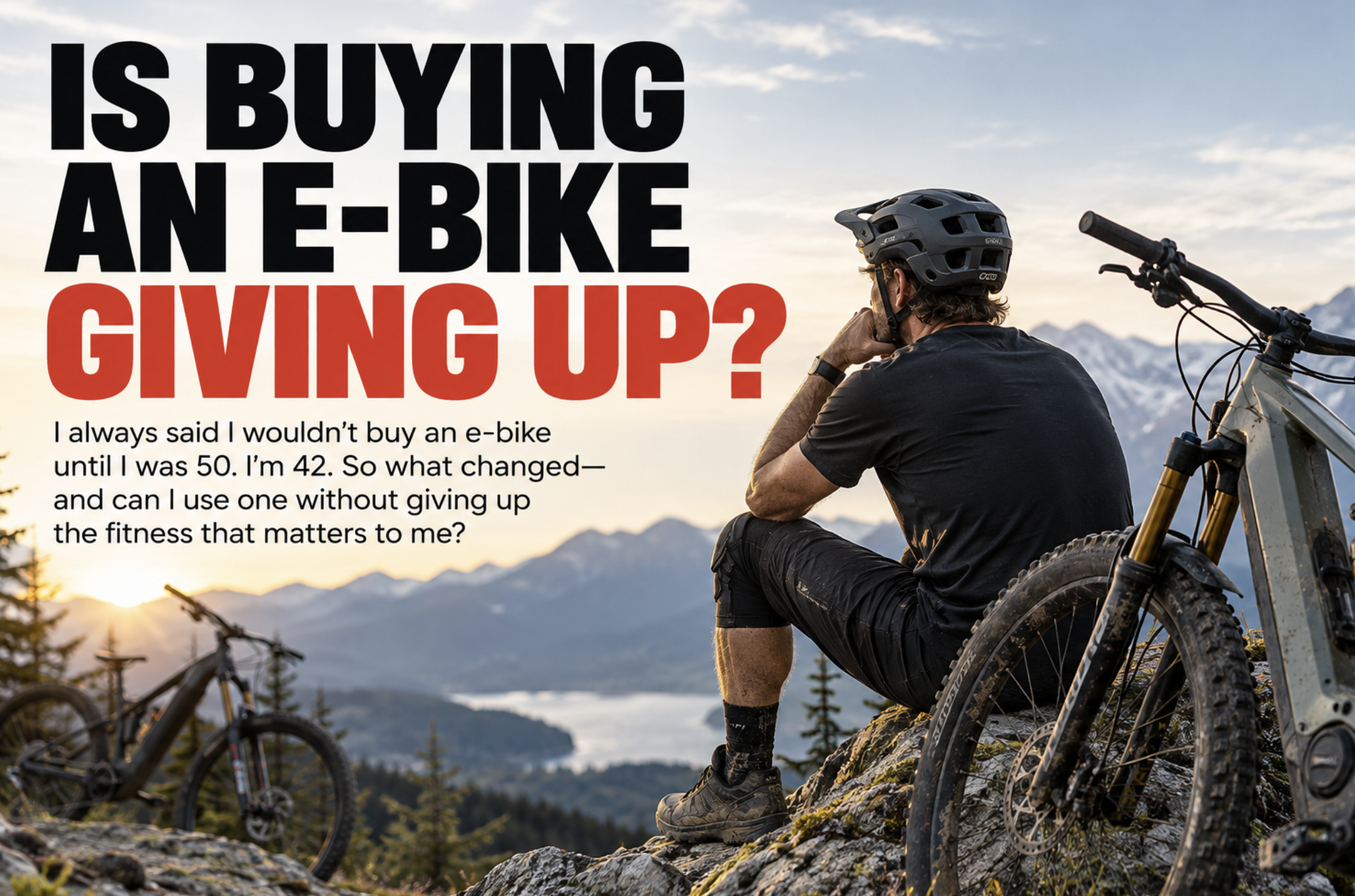
Until fairly recently, my answer—at least when it came to myself—was pretty much yes.
I never thought e-bikers were cheating.
Cheating at what?
If you’re riding your bike with your mates, there’s no competition. Nobody is keeping score.
But I did think buying an e-bike meant giving up something that I valued about mountain biking.
The mountain keeps you honest.
I always said I wouldn’t consider an e-bike until I was 50.
I’m 42.
Apparently 50 has arrived eight years early.
Why Do We Enjoy Doing Horrible Things in the Mountains?
I moved to Vancouver in 2006, and I’ve spent a surprising amount of time since then thinking about why I enjoy doing objectively unpleasant things in the mountains.
The Grouse Grind was probably where I first really noticed it.
At some point, I discovered that I actually enjoyed doing the Grind.
Which doesn’t make much sense.
You walk uphill as hard as you can. Your legs hurt. Your lungs hurt. You’re sweating everywhere. And unlike most mountain activities, there isn’t even a fun descent waiting for you at the top.
Objectively, it’s not particularly pleasant.
But I kept going back.
I suppose we’d now call it Type 2 fun.
The enjoyment isn’t necessarily in how you feel while you’re doing it. It’s how you feel immediately afterwards—and what happens over the longer term when you repeatedly expose yourself to difficult things as part of a thoughtful training program.
You get fitter.
Something that used to feel impossible becomes manageable.
Then you try to do it a little faster.
And somewhere along the way, I realized there was something else I liked about climbing mountains.
The Mountain Keeps You Honest
When I was injured and unable to play rugby for the best part of a year, I took up road cycling with a few of my clients.
Before long, I’d found my favourite ride.
I’d drive across Vancouver to Cypress Mountain, park at the bottom, get my road bike out…
…and ride up the hill.
Then I’d ride back down.
That was basically it.
I’d driven across an entire city to ride a bicycle up and down the same mountain.
What was that all about?
Looking back, I think I loved the simplicity of it.
The mountain doesn’t change.
It doesn’t care whether you’re fit.
It doesn’t care whether you’re tired.
It doesn’t care what your FTP is, whether your training has gone well or whether you had a terrible night’s sleep.
You can climb it quickly.
You can climb it slowly.
You can stop halfway.
But the mountain stays exactly where it is.
You either get yourself to the top or you don’t.
There’s something wonderfully honest about that relationship.
Then E-Bikes Arrived
When the great mountain-bike e-bike debate started, I didn’t really understand why there was a debate.
As far as I was concerned, they were motorized vehicles.
We had non-motorized trails.
Therefore motorized vehicles shouldn’t be on them.
Simple.
But I didn’t care enough about the issue to become a card-carrying member of the Grumpy Old Men Club.
I wasn’t interested in campaigning against e-bikes.
I just knew they weren’t for me.
And again, it wasn’t because I thought e-bikers were cheating.
My objection was much more personal.
I felt like the motor contaminated the relationship between the human and the hill.
The mountain was no longer asking the question and waiting for you to provide the entire answer.
There was something else involved.
So I made myself a completely arbitrary rule.
Maybe when I’m 50.
At 50, perhaps I’d buy an e-bike.
Until then, I’d pedal.
Apparently 50 Has Arrived Eight Years Early
One by one, my riding buddies have—in my words—“given in.”
They’ve bought e-bikes.
For a while, that didn’t really matter.
Then you gradually become the guy turning up to an e-bike ride without an e-bike.
I also coach mountain bikers for a living, and more and more of the athletes I work with own e-bikes—either as one bike in their quiver or as their only mountain bike.
There are work projects where an e-bike would be genuinely useful.
And I have an impatient six-year-old who occasionally needs towing around behind me.
At some point, stubbornly refusing to own one starts becoming less of a principled stand and more of a logistical pain in the arse.
So here I am.
Looking at e-bikes.
Begrudgingly.
But the more seriously I’ve considered owning one, the more I’ve realized that my biggest concern isn’t actually the bike.
It’s me.
With Great Power Comes Great Responsibility
I know myself pretty well.
If there’s a button underneath my thumb that can make a horrible climb considerably easier, I’m probably going to want to press it.
That’s not a criticism of anyone else’s riding.
It’s an acknowledgement of my own mental weakness.
On my acoustic bike, effort is built into the deal.
If I want to get myself and my bike to the top, I have to provide the energy required to do it.
I can go slower.
I can stop.
I can turn around.
But I can’t ask my bike to quietly contribute another couple of hundred watts because my legs hurt and I’d rather be at the top already.
An e-bike fundamentally changes that relationship.
It doesn’t mean I can’t work hard.
It means I don’t have to.
And I think that’s an important distinction for anyone who rides an e-bike and still cares about their fitness.
The motor gives you a choice that wasn’t there before.
The onus for effort now lies with you.
You have to explicitly opt in to effort.
With great power comes great responsibility.
Quite literally, in this case.
So I’m Not Replacing My Mountain Bike
This is important.
My acoustic bike isn’t going anywhere.
It will remain my daily mountain bike.
It’s the bike I’ll train on most of the time.
It’s the bike I’ll race.
And when I just want to go mountain biking, it’s the bike I intend to reach for.
The e-bike has a much narrower job description.
This is going to be a work and training tool.
I’ll use it for projects where I specifically need an e-bike.
I’ll use it when the objective of a training session gives me a reason to use one.
And I’ll use it when my e-biker dad-gang heads out and I don’t particularly fancy making everyone wait for me at the top of every climb.
Otherwise, I’m considering installing a pane of glass across it in the garage with a little sign:
- BREAK IN CASE OF EMERGENCY.
- I’m joking.
- Mostly.
Because I don’t want convenience to quietly become the reason I choose which bike to ride.
“It’s Just as Good of a Workout” 🤥
There’s another reason I’m increasingly interested in all of this.
I’m coaching more e-bike riders.
And I’ve actually been relieved to discover that most of them still care deeply about their fitness.
They want endurance.
They want to be strong.
They want to ride hard for longer.
And many of them specifically don’t want buying an e-bike to mean giving up on their physical capacity.
Good.
Because I don’t think it has to.
But eventually, somebody always tells me some version of:
- “Honestly, it’s just as good of a workout.” 🤥
- Sure it is.
- Or rather—it absolutely can be a serious workout.
- But that’s not quite the same thing.
If endurance matters to you, I think owning an e-bike actually requires you to become more deliberate about your endurance training, not less.
How hard are you actually working?
How much work are you producing?
How much time are you spending at the intensity you intended?
What was the purpose of today’s ride?
And did the motor help you achieve that purpose—or did it simply make the uncomfortable bits more comfortable?
Those aren’t criticisms of e-bikes.
They’re training questions.
And they’re questions I’m increasingly being asked to answer for the athletes I coach.
So I’m going to devote an entire article to them next.
And What About Strength?
This is where things get even more interesting.
Because while the motor can reduce some of the physical demand of getting uphill, an e-bike can potentially increase your exposure to almost everything that happens afterwards.
The bike is heavier.
You can cover more terrain.
You can get back uphill faster.
Which potentially means:
- More laps.
- More descending.
- More braking.
- More corners.
- More compressions.
- More impacts.
- More technical riding.
- The motor can help propel the bike uphill.
It doesn’t manage the bike for you on the way back down.
So there’s a reasonable argument that strength training doesn’t become less important for an e-bike rider.
It might actually become more important.
That’s another question that deserves considerably more attention than I’m going to give it here.
And it’ll be Part 3 of this series.
Can an E-Bike Actually Make Me Fitter?
This is the question that has finally taken me from reluctant acceptance to genuine curiosity.
Because an e-bike doesn’t only allow me to make mountain biking easier.
It potentially allows me to manipulate the physical demands of riding.
Could I use assistance to control intensity?
Could I accumulate more aerobic volume without generating as much fatigue?
Could I perform hard efforts and use assistance to recover between them?
Could I get more technical climbing practice?
Could I dramatically increase my descending exposure without also dramatically increasing the metabolic cost of earning every lap?
Could I use an e-bike on days when additional acoustic riding would interfere with another part of my training?
Could I use it to become a better rider?
And ultimately:
Could I use an e-bike to actually become fitter?
I don’t know.
So I’m going to find out.
The E-Bike Training Experiment
Rather than arguing about what an e-bike theoretically might do to my fitness, I’m going to put one into my own training and collect some data.
My acoustic bike stays as my daily ride and race bike.
The e-bike gets used deliberately.
I’ll look at things like:
* ride duration
* heart rate
* my own power output where I can measure it
* elevation
* assistance level
* training load
* descending volume
* recovery
And then I’ll periodically take the motor away.
That’s one reason I’m deliberately keeping acoustic racing in my annual calendar.
However sophisticated the data becomes, I still want something brutally simple to keep me honest.
Every so often, I’ll put a number on my bike and line up for a race with no motor underneath me.
If I’ve maintained or improved my fitness, great.
If I’ve gradually become extremely good at pressing the boost button…
the mountain will call bullshit.
And that’s exactly what I want.
The E-Bike Training Series
So this article is really the beginning of an experiment.
Over the coming months, I’m going to tackle three questions in detail:
Part 2: How Do You Actually Train Endurance on an E-Bike?
If “it’s just as good of a workout” isn’t enough, what should we actually measure?
We’ll look at heart rate, rider power, perceived effort, assistance levels and how to give an e-bike ride a deliberate training purpose.
Part 3: Strength Training for E-Bike Riders
Does a motor reduce the need to be strong—or do heavier bikes, higher riding exposure and more descending actually increase the physical demands on the rider?
We’ll look at what your body needs to be able to do and how to train it.
Part 4: Can an E-Bike Make You Fitter?
This one will take some time.
I’ll use the principles from Parts 2 and 3 in my own training, collect the data, keep riding and racing my acoustic bike…
…and report back on what actually happens.
Maybe I’ll discover I’ve been unnecessarily stubborn about e-bikes for the last decade.
Maybe some of my concerns will turn out to be justified.
Probably a bit of both.
Either way, we’ll have something more useful than another argument about whether e-bikes are cheating.
We’ll have data.
And I’ll still have the mountain to keep me honest.
⸻
Ride an E-Bike and Still Care About Being Fit?
Good.
Whether you ride an e-bike, an acoustic bike or have a garage full of both, my job isn’t to train you for a particular type of bike.
It’s to make the rider stronger, fitter and more capable.
If you’re not sure what’s actually limiting your riding right now, start with my MTB Fitness Assessment.
Find your strengths. Find the gaps. Then train what actually needs improving.
→ Take the MTB Fitness Assessment
Next in the series: How to Train Endurance on an E-Bike—and Why “It’s Just as Good of a Workout” Is a stretch...