How I’m planning to use an e-MTB for endurance training this winter — without letting the motor do the work I still need to be able to do myself.
In Part 1 of this series, I explained why I’m finally considering buying an e-bike eight years earlier than planned.
I always said I’d wait until I was 50.
I’m 42.
My biggest concern isn’t really the bike. It’s me.
Give me a button that makes a horrible climb easier and, eventually, I’m probably going to press it.
That led me to the idea that once you own an e-bike, the onus for effort shifts onto you. You have to opt in to effort.
But that leaves me with a much more interesting question.
What if I don’t just use an e-bike without getting less fit?
What if I can use one to get fitter?
That’s what I’m going to try to find out this winter.
And there are really three questions I want to answer:
Can I use an e-bike to get fitter — enough to actually help justify owning one?
Can I deliberately train on an e-bike without sucking the fun out of mountain biking?
And perhaps most interestingly:
Can having an e-bike actually enhance the training process — through better results, more enjoyment, or both?
First, What Does “Fitter” Actually Mean?
Before I decide whether an e-bike can make me fitter, I probably need to define what I mean by fitness.
For me, fitness is capability.
It’s being capable as a father, husband, rider and coach.
It’s being able to ride further and take on bigger days.
It’s saying yes when someone suggests a cool adventure rather than quietly wondering whether I’m fit enough to survive it.
More broadly, I never want to have to avoid a physical challenge simply because I’m not physically up to it.
That’s a much bigger goal than getting faster at one particular race.
But I’ve found that having something on the calendar gives that philosophy teeth.
For the last few years, the Squamish Enduro short course has been my annual barometer. It gives me a reason to train and, once a year, forces me to find out whether the fitness I’ve been building actually translates into being a capable mountain biker.
There’s just one problem.
The short course doesn’t scare me enough anymore.
I know I can do it.
And apparently I need at least a small amount of fear to keep myself honest.
So in 2027, it’s time to step up to the full Squamish Enduro.
I’m not expecting one race to perfectly measure my fitness. But it gives me an excellent built-in training motivator and an annual reality check.
And crucially for this experiment, I’ll be doing it without a motor.
Whatever clever things I manage to do with assistance through the winter, eventually I have to turn up with my acoustic bike and the body I’ve built.
There’s nowhere for my fitness to hide.
“It’s Just as Good of a Workout” 🤥
I hear some version of this fairly regularly:
“E-biking is just as good of a workout.”
Maybe.
You absolutely can get a great workout on an e-bike.
You can also ride for three hours, climb a ridiculous amount of vertical and let the motor do a substantial proportion of the work.
Neither of those statements makes e-bikes good or bad.
They just demonstrate why “Was it a good workout?” isn’t a particularly useful training question.
A better question is:
What was I trying to train today, and did the ride actually provide that stimulus?
That’s the same question I ask when programming any athlete.
The interesting thing about an e-bike is that the motor gives us another variable to manipulate.
And I think that could be incredibly useful.
Mountain Bike Trails Are Terrible Ergometers
If you’ve ever done structured endurance training on an indoor trainer, you know how beautifully controlled cycling can be.
Pick a power.
Hold it.
Change the power.
Recover.
Repeat.
Now try doing that on a mountain bike trail in Squamish.
The trail couldn’t care less about your training plan.
The gradient changes. Roots appear. There’s a rock in exactly the wrong place. You have to stand up. Sit down. Accelerate. Coast. Pump through something. Ratchet the cranks through a technical section.
Then someone stops in front of you.
Mountain biking also places some very specific demands on how we produce power.
On a smooth road climb, you have considerable freedom to choose your cadence.
On a mountain bike, sometimes you deliberately need a slower cadence to avoid pedal strikes. Sometimes you only have enough room for half a pedal stroke. Sometimes you’re ratcheting the cranks. Sometimes you’re repeatedly getting in and out of the saddle as the terrain changes.
Then there are all the little accelerations required to get over and around things.
That matters because cycling power comes from the interaction between how much torque you’re producing and how quickly you’re turning the pedals.
Technical mountain biking can demand a lot of torque.
Now add a motor.
The bike can provide some of the torque that previously had to come from you.
That’s fantastic when that’s what we want.
But if the adaptation we’re chasing requires you to produce that force, we need to account for it.
The Motor Isn’t Just Assistance. It’s a Training Variable.
This is where I think things get much more interesting than the usual e-bike fitness argument.
We tend to think of assistance as a continuum between:
MORE MOTOR = EASIER
and
LESS MOTOR = HARDER
From a training perspective, that’s too simplistic.
Instead, I want to ask:
What is the purpose of today’s ride — and how much assistance helps me achieve it?
I’ve already used this idea with e-bike athletes I coach.
For some riders, the e-bike isn’t part of a quiver.
It’s simply their mountain bike.
I’ve programmed sustained climbing intervals for riders like this where we’ve deliberately reduced the assistance.
There’s an obvious reason: I need the rider doing more of the work.
But there’s another benefit.
It makes the hill longer.
If the motor gets you to the top of your local climb too quickly, that climb might not be long enough to provide the sustained interval we’re looking for.
Reduce the assistance, slow the bike down, increase the rider’s contribution and suddenly the same mountain gives us a longer working interval.
We’re not pretending the motor isn’t there.
We’re manipulating it to create the training stimulus we want.
Sometimes I Want the Motor to Do More
I’ve also coached riders who own both an e-bike and an acoustic bike.
That’s a different opportunity.
Imagine I want an athlete to have a skills-focused day.
I want them descending. I want corners, line choice, technical riding, maybe jumps. I want repetitions.
What I don’t necessarily want is another significant endurance session squeezed between their other training.
That’s a pretty good day to take the e-bike.
Use more assistance on the climbs. Keep the pedalling genuinely easy. Get some low-intensity movement between descents, but save the athlete’s training budget for the thing we’re actually trying to improve.
The motor hasn’t made the session worse. It’s made the session more specific.
And there’s another potential advantage here.
If the e-bike gets me back to the top with less fatigue, I can potentially start the next descent fresher.
That could mean more high-quality technical repetitions, rather than simply more tired laps.
More corners.
More line choices.
More pumping.
More jumps.
More time riding technical terrain.
Over an entire Squamish winter, that could add up.
That’s one of the things I want to test.
The Easy Button Is Still the Problem
There’s another side to all of this.
The biggest risk might not be physiological.
It might be behavioural.
Five minutes into a hard climb on my normal bike, I have a fairly limited set of options.
I can keep pushing.
I can slow down.
Or I can stop.
On an e-bike there’s another option sitting underneath my thumb:
Make it easier.
That’s fantastic when making the effort easier is part of the training plan.
It’s potentially a problem when I’m reaching for it simply because the effort has become uncomfortable.
And that’s exactly the sort of thing I’m concerned about with my own training.
Five-minute efforts hurt.
Twenty-minute efforts definitely hurt.
If every time things get uncomfortable I unconsciously start adding assistance, I may gradually remove exactly the sustained hard work I need to preserve.
There’s a torque question too.
If the motor repeatedly provides the torque required for steep climbs, accelerations and technical sections, what happens to my own ability to produce those harder efforts?
So this experiment can’t simply ask:
“Did I ride a lot?”
I need to know what happened to the physical qualities underneath it.
Conveniently, I’ve already taken the before picture.
My September MTB Climbing Profile
Over the last few months, I’ve been developing a mountain-bike-specific climbing field test.
The idea came from a question I get from riders all the time:
“Why am I struggling on climbs, and what should I actually train to get better?”
Because climbing fitness isn’t one thing.
You can have a good engine but struggle to sustain it.
You can be good at a long steady climb but struggle when the trail repeatedly asks you to go hard.
Or you can be great early in a ride and fall apart later.
The test is designed to start separating those qualities without requiring a laboratory, smart trainer or even a power meter. It uses sustained efforts, repeated shorter climbing efforts and fresh-versus-late riding to build a more complete picture of how a rider climbs.
I completed my own baseline in September, before introducing an e-bike into my training.
My September baseline
And then there’s the part I’m particularly interested in protecting: my repeated hard uphill efforts.
My five repeat efforts produced approximately:
840 → 687 → 775 → 735 → 699 VAM
That shape matters.
It tells me much more than simply saying I completed five hard efforts.
It shows what I can produce at my best, how much I lose, whether I can recover some performance after an early drop, and how much remains by the final effort.
MY SEPTEMBER MTB CLIMBING PROFILE
This is my before picture.
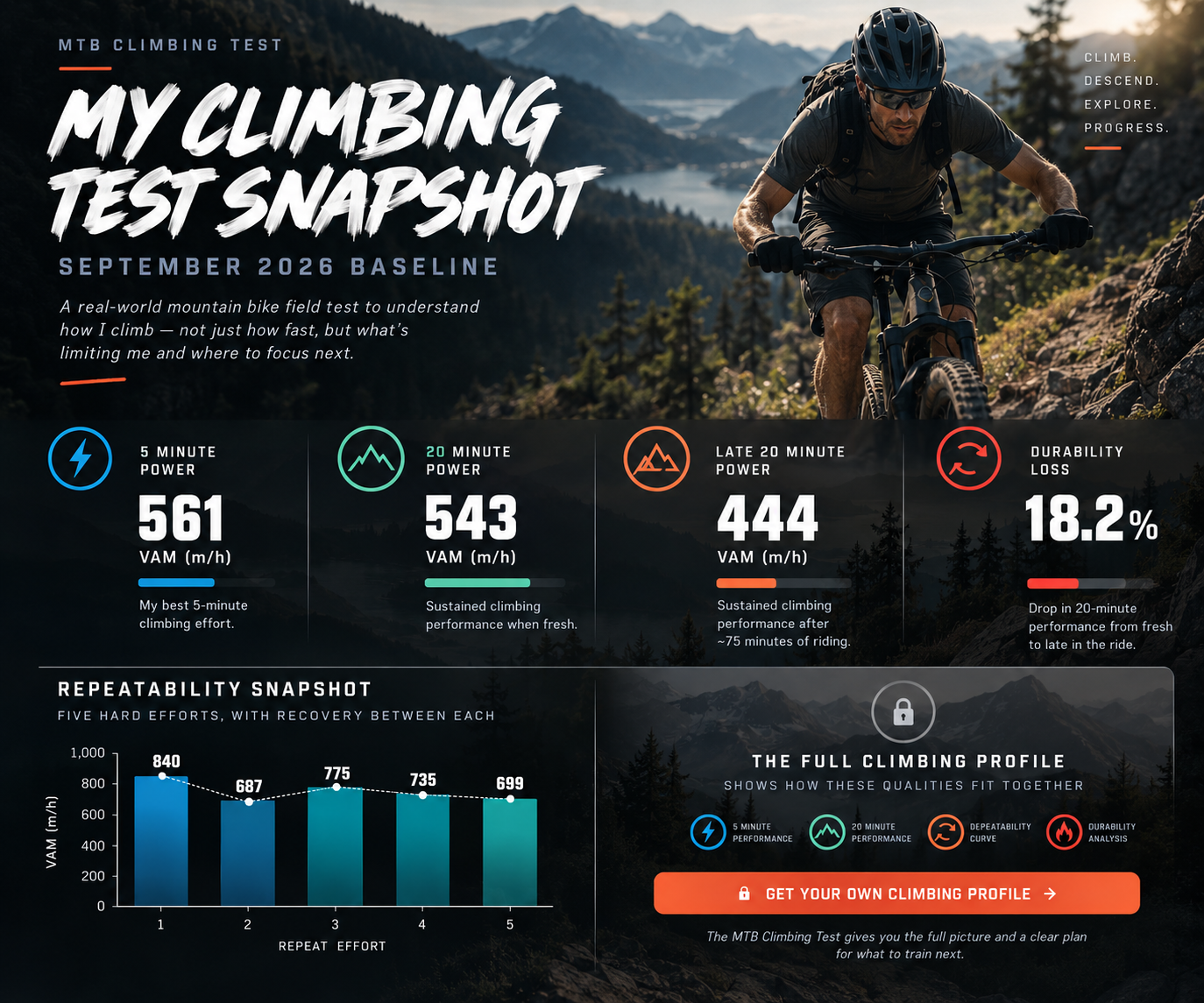
I’m deliberately not declaring one part of it my definitive weakness yet. I’m currently beta-testing the system with other riders, and I want more data before deciding exactly how the different profiles should be interpreted.
But for this experiment, that’s not actually necessary.
Because I know what I want to happen.
I want the whole thing moving forward.
This Test Should Keep the E-Bike Honest
This is where my climbing profile becomes particularly useful.
If I spend the winter accumulating huge amounts of vertical on an e-bike, I could easily convince myself I’m getting fitter.
My test gives me a way of asking a harder question.
Am I actually becoming more capable when the motor isn’t there?
My five-minute result tells me something about my ability to sustain a very hard climbing effort.
My 20-minute result looks further into sustained climbing performance.
My repeatability curve lets me see whether I can still produce hard, short-duration climbing efforts and keep reproducing them.
And the fresh-versus-late comparison tells me what happens to my climbing deeper into a ride.
Those are exactly the qualities that could be compromised if I use the e-bike badly.
If I start pressing the button whenever sustained climbing becomes uncomfortable, my five- and 20-minute performance could suffer.
If I allow the motor to continually provide torque that I previously had to produce myself, my shorter hard climbing performance could suffer.
And if I simply become very good at accumulating motor-assisted vertical without developing the underlying fitness, eventually the retest should expose it.
That’s the point.
I don’t want to become better at riding an e-bike.
I want to use an e-bike to become a better mountain biker.
What Would I Normally Do This Winter?
My normal off-season endurance training isn’t particularly complicated.
Coming out of the riding season, I deliberately back things off for a while.
That’s roughly where I am now.
Recently I’ve been averaging around two pedal rides per week during an intentional chill period.
When it’s time to start building again, I gradually increase my easy riding volume.
My first target is simply getting back to at least three rides per week consistently.
Early in the build, most of that work is relatively easy.
If Squamish weather makes riding outside miserable — or life gets in the way — I’ll use indoor rides when I have to.
Then, as I get closer to the event, more higher-intensity work starts entering the picture.
Strength training stays in all year.
I don’t think of strength and endurance as two completely separate programs fighting for space.
I modify the intensity and volume of my strength work as the bike training changes so that my hardest gym work isn’t constantly clashing with my hardest work on the bike.
That’s the basic system.
I’m not throwing it away because I’ve bought an e-bike.
I’m asking whether the e-bike can make that system better.
So How Am I Going to Use the E-Bike?
I’m not replacing my acoustic bike.
That’s important.
It’s still going to be part of my training, my normal riding and ultimately my racing.
Instead, I’m going to introduce the e-bike where I think it can improve the training process.
That means using assistance deliberately.
For an easy aerobic ride, assistance might help me prevent steep Squamish terrain from constantly pushing me harder than I want to go.
For sustained climbing work, I can reduce the assistance and make sure I’m still contributing meaningful torque.
For harder interval sessions, I can potentially make the hard efforts genuinely hard and use more assistance during the recovery so that the easy parts are genuinely easy.
For technical or skills-focused riding, I can spend less of my training budget getting back uphill and potentially accumulate more high-quality descending.
And on days when I want time on the bike without a big additional physiological hit, the e-bike may let me ride rather than deciding that another acoustic ride costs too much.
The target while I’m building is still at least three rides per week.
The experiment isn’t necessarily about riding more.
It’s about whether having two different tools lets me make those rides better suited to the job they’re supposed to do.
Although if the e-bike makes riding so enjoyable that I end up riding more as well?
That’s useful information too.
How Much Stuff Do I Need to Measure?
This is where endurance training can get ridiculous.
Power meters. Heart-rate straps. GPS computers. Training platforms. Zones. Charts. Graphs. Spreadsheets.
I like this stuff.
You might not.
Everyone has both a financial budget and an interest budget for training data.
Go as far into the weeds as you want.
At the simplest level, almost everyone can track things like:
Time. Distance. Elevation. Effort.
GPS gives us speed and climbing speed.
A heart-rate monitor adds another useful layer. Heart rate isn’t the same as power — and it responds more slowly when intensity changes — but over longer efforts it tells us a lot about the physiological cost of the work.
Rider power becomes particularly interesting with an e-bike because I want to distinguish between what the bike is doing and what I’m doing.
And then there’s one of the oldest training tools available:
How hard did that feel?
I don’t need every ride to become a science experiment.
I need enough information to answer the questions I’m interested in.
What Would a Perfect Result Look Like?
I’m not doing this experiment hoping to prove that I can ride an e-bike all winter without getting less fit.
That’s a pretty uninspiring target.
I want the whole profile to move forward.
Better five-minute performance.
Better sustained 20-minute climbing.
Better repeatability.
Better durability.
And I don’t want an improvement in one area to come at the expense of another.
But fitness is only half of it.
I want to become a better rider too.
If the e-bike gives me more descending laps through the winter — and lets me arrive at some of those descents fresher — I potentially get more high-quality repetitions of cornering, line choice, pumping, jumping and technical riding.
So the perfect outcome isn’t:
“The e-bike didn’t make me less fit.”
It’s:
I’m fitter across the climbing profile, I’ve accelerated my technical progression through more quality laps, and I’ve had more fun getting there.
The numbers are measurements.
Capability is the goal.
I want to be able to ride further.
Handle bigger days.
Say yes to cool adventures.
Be physically capable as a father, husband, rider and coach.
And when the 2027 Squamish Enduro full course arrives, I want to know I’ve prepared myself for something that genuinely challenged me.
If the e-bike helps me do all of that, it hasn’t helped me avoid the work.
It’s helped me do better work.
Already Ride an E-Bike and Want to Get Fitter?
You don’t need to wait for the results of my experiment.
I already coach mountain bikers who ride e-bikes exclusively, riders who own both, and riders who spend most of their time on acoustic bikes.
The training principles haven’t suddenly changed because there’s a motor attached to the bike.
The job is still to understand what you’re trying to improve, what your riding currently demands from you and what is actually limiting your performance.
Then we manipulate your riding and strength training accordingly.
That’s something we can do now.
And if you’re interested in finding out what your own climbing profile looks like, that’s exactly why I’m developing the MTB Climbing Test.
Two riders can both say:
“I need to get better at climbing.”
One may need more sustained performance.
Another may need repeatability.
Another may be fine when fresh and fall apart deeper into a ride.
Those riders shouldn’t necessarily train the same way.
Find the limiter. Then train the limiter.
Take the MTB Fitness Assessment → [
One More Thing: E-Bikes Are Bloody Heavy
We’ve mostly talked about endurance here.
But there’s another part of this that I think gets overlooked.
E-bikes are heavy.
The motor can reduce the amount of work required to propel that extra mass uphill.
It doesn’t make the mass disappear when you start riding the bike.
You still need to control it through corners, deal with compressions, brake, accelerate, move the bike underneath you, resist and redirect forces and recover it when things don’t go perfectly.
And if the motor means you’re doing more laps, you may be exposed to those demands more often.
Which leads me to another idea that sounds slightly backwards:
Strength training might actually matter more for e-bike riders, not less.
That’s Part 3.
⸻
Part of the E-Bike Training Series
Part 1 — Is Buying an E-Bike Giving Up?
Why I’m considering one eight years earlier than planned — and why I think owning an e-bike means taking more responsibility for your effort, not less.
Part 2 — Can I Use an E-Bike to Get Fitter?
You’re here.
Part 3 — Why Strength Training Might Matter MORE for E-Bike Riders
The motor helps move the bike uphill. You still have to handle a heavier machine everywhere else.
Part 4 — The E-Bike Training Experiment
After a winter of training, I’ll repeat the climbing profile, look at what happened to my riding and fitness, and eventually put it all to the test without a motor.