Getting stronger after 40 isn't about working harder to fight the changes in your body. It's about getting the training dose right, recovering well and making sure your hard work actually pays off.
Don't Assume You Can't
One of the first things I want women over 40 to understand is that getting older doesn't mean you have to accept getting weaker, slower or less capable on your mountain bike.
Your body might not respond to training exactly as it did when you were 25. But you've also got something you probably didn't have at 25: experience.
You're wiser. You understand your priorities. You're often better at following a plan, being consistent and recognizing when something isn't working.
And those qualities count for an awful lot.
I've coached plenty of younger athletes with tremendous physical potential who struggle to string together a few consistent months of training.
Meanwhile, a woman in her 40s or 50s who trains intelligently, follows her program and makes steady progress can achieve remarkable things.
Don't underestimate what consistency and a good plan can accomplish.
The biggest mistake isn't getting older. It's assuming your best training years are already behind you.
1. Stop Trying to Outwork the Changes in Your Body
Something I see regularly with women entering their 40s is a growing frustration with changes in body composition, energy and recovery.
The response is often to do more.
Another workout. More cardio. More intervals. More time on the bike. Perhaps a harder gym session because the last one didn't feel hard enough.
It's understandable. You've worked hard to be fit, and you don't want to lose it.
But more work isn't always more productive work.
Training creates a stimulus. Your body responds to that stimulus during the recovery and adaptation process.
If you keep piling on training without allowing enough recovery, you can accumulate fatigue faster than you develop fitness.
That's why I want my clients thinking about the dose of training rather than simply how much they can tolerate.
Enough strength training to build muscle and improve force production.
Enough high-intensity riding to develop power and cardiovascular fitness.
Enough easier work to support aerobic development without adding unnecessary fatigue.
And enough recovery to actually benefit from it all.
The goal isn't to finish every workout exhausted. The goal is to become more capable.
2. Get Your Training Dose Right
You may have heard of the supercompensation curve.
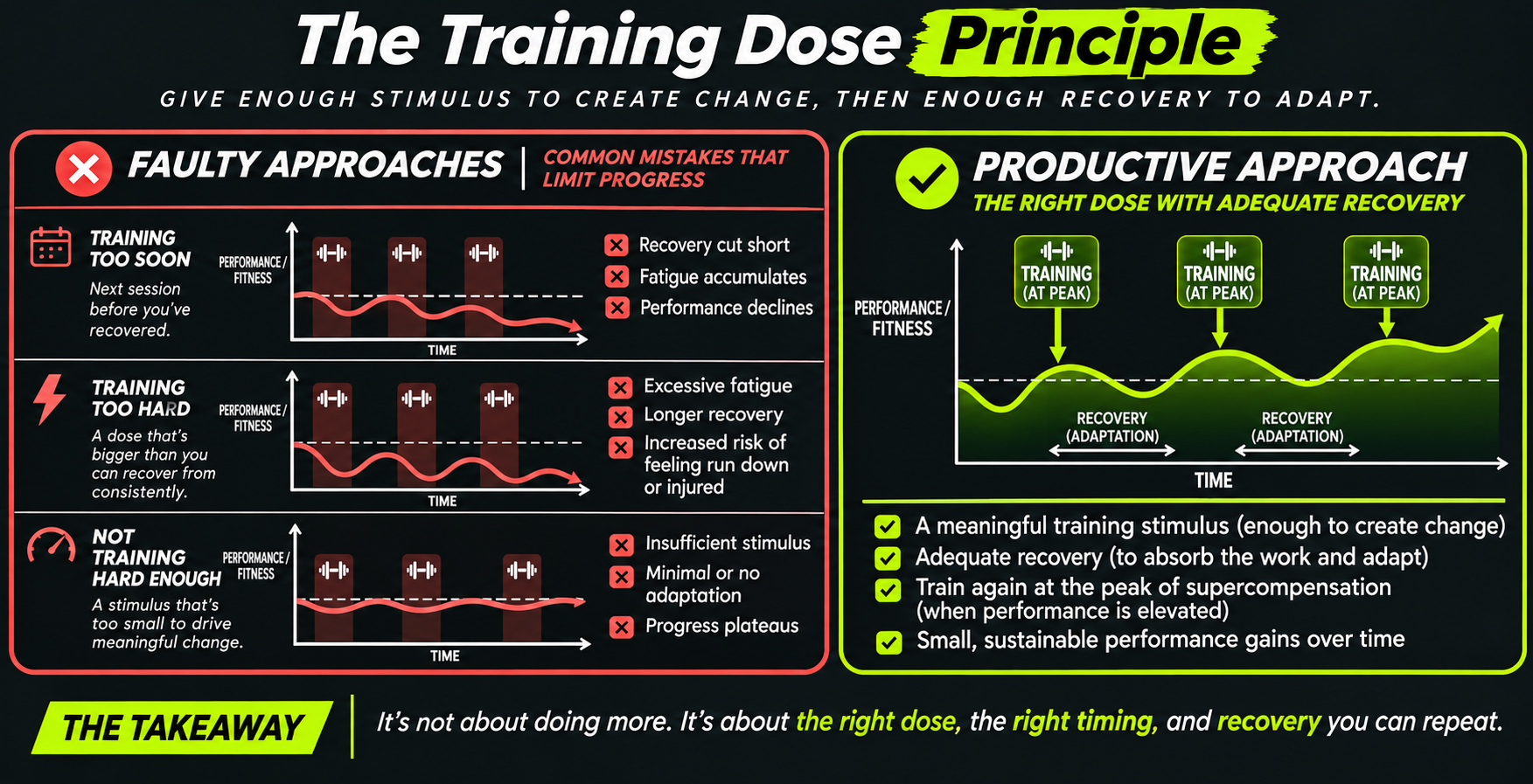
It's a simplified way of explaining how a training session creates fatigue, followed by recovery and, with appropriate training over time, improved performance.
Does menopause automatically change that curve?
We don't have strong evidence that every woman experiences a predictable change in the timing of supercompensation during menopause.
But we do know that sleep disruption, symptoms, changes in body composition and other factors can affect how women experience and respond to training.
From a coaching perspective, that makes paying attention to the individual response especially important.
I want to provide enough stimulus to create an adaptation, but not so much that the athlete spends the rest of the week trying to recover from it.
What does that look like?
Let's say you've got two gym sessions, one structured interval ride and a big weekend group ride planned.
If the gym sessions are progressing, your interval performance is improving and you're recovering well between workouts, fantastic.
We don't need to change anything.
But if your strength numbers are falling, you're struggling to complete intervals and your legs feel permanently heavy, something needs adjusting.
That might mean reducing the number of sets in the gym, moving a hard ride or adding another recovery day.
It doesn't necessarily mean reducing the weights or avoiding intensity altogether.
My coaching rule: Give your body a reason to adapt, then give it the opportunity to do so.
3. Measure Progress Instead of Assuming It's Happening
Muscle and bone still respond to appropriate mechanical loading as we age.
Progressive resistance training remains one of the most valuable tools we have for developing strength, preserving muscle and supporting bone health.
The underlying principles haven't suddenly changed because you're over 40.
But I don't want my clients assuming that their training is working simply because they're exercising regularly.
I want evidence.
Measure what matters
In the gym, we can track the weights you're lifting, the repetitions you're completing and how your strength progresses over time.
On the bike, we can measure climbing performance, repeat sprint ability, power output where available and how well you maintain performance as fatigue accumulates.
For muscle and bone health, a DXA scan can provide useful additional information when appropriate.
I encourage women to discuss bone-density screening with their healthcare provider, particularly if they have risk factors for osteoporosis or a history of fractures. The need for a baseline scan and the interval between scans should be determined by individual risk and clinical guidance, rather than automatically scanning every year.
Body-composition assessments can also be useful in some circumstances, provided they're interpreted consistently and don't become the sole measure of progress.
The point isn't to obsess over every number.
It's to establish a baseline, follow a plan and check whether it's delivering the results we want.
If you're getting stronger, maintaining or building muscle and performing better on the bike, that's meaningful progress.
Don't confuse being busy with getting better.
4. Keep Lifting Heavy. And Don't Forget Power.
I don't automatically replace heavy strength training with light weights and endless repetitions when a woman turns 40.
If she's capable of lifting heavier weights with good technique, we're going to work toward doing exactly that.
Squats, hinges, presses, pulls, carries and single-leg exercises all have a place in the program.
We'll choose the variations that suit her movement ability, injury history, experience and goals.
Then we'll progressively load them.
Muscle and bone need a meaningful stimulus
Muscle responds to progressive resistance training, and bone health benefits from appropriate weight-bearing and resistance-loading activities.
For women approaching or moving through menopause, maintaining muscle mass and bone strength is particularly valuable.
But there's another quality I don't want us to neglect.
Power.
Power is the ability to produce force quickly.
On a mountain bike, that matters when accelerating out of a corner, sprinting up a short climb, pumping terrain or reacting quickly to a technical feature.
And the ability to produce force rapidly is also valuable for physical function as we age.
In the gym, that might mean introducing appropriate jumps, medicine-ball throws or fast, controlled lifting movements.
The exercises and intensity depend on the individual. We don't need to start with aggressive plyometrics if someone hasn't developed the capacity for them.
But we should have a plan to develop power rather than ignoring it.
Sprint on your bike, too
Short, hard sprint efforts are a useful way to train explosive performance on the bike.
Depending on the duration, recovery and session structure, sprint intervals can also contribute to high-intensity conditioning.
I distinguish between very short maximal sprints with generous recovery, which emphasize peak power, and longer or repeated hard efforts that create a greater cardiovascular demand.
Both can be useful.
The key is choosing the right session for the quality we're trying to develop.
Getting older isn't a reason to stop training fast. It's a reason to make sure you keep that ability.
5. Sleep Disruption: Work With It, Not Against It
Sleep is one of the biggest practical challenges I encounter when coaching women through perimenopause and menopause.
Night waking, early waking, hot flashes and unpredictable sleep quality can make it difficult to maintain a consistent training schedule.
But I don't automatically tell someone to skip training because they've had a poor night's sleep.
Instead, we find a routine that works for her.
Sometimes an early workout works beautifully
Some women find themselves waking earlier than they used to.
If they're awake, reasonably rested and ready to move, an early workout can be a great opportunity.
I've seen clients establish very consistent morning training routines this way.
Regular exercise, morning daylight and a consistent wake time may also help support a healthy sleep-wake rhythm.
But there's a difference between making good use of an early start and deliberately sacrificing sleep to fit in more training.
Sometimes the best option is to train later
Other women feel terrible after a disrupted night.
Forcing a hard gym session at 6 a.m. isn't always the smartest decision.
Sleep a little longer if you can. Move the workout to lunchtime or the afternoon. Or take the day off if that's what you need.
One missed workout won't derail your progress.
And if you're regularly needing extra recovery days, we should review the program rather than continuing to force the schedule.
Persistent sleep problems also deserve appropriate medical attention. Training adjustments can help manage their impact, but they aren't a substitute for treating the underlying problem.
Make your training environment comfortable
Temperature regulation can be another challenge, especially for women experiencing hot flashes.
This is one of those areas where simple solutions can make a real difference.
Get a fan. Open the window. Open the garage door if you're training at home.
Wear clothing that's easy to adjust, keep water nearby and choose a cooler training space when possible.
There's no prize for suffering through an unnecessarily hot workout.
The best training environment is one that allows you to train effectively and consistently.
6. Stop Turning Every Ride Into a Hard Ride
This might be one of the most important lessons for mountain bikers.
You head out for what was supposed to be an easy ride.
Then you meet your friends.
Someone picks up the pace on the climb. You don't want to get dropped. The next climb gets a little competitive.
Before you know it, your easy aerobic ride has become another moderately hard workout.
I often describe this as spending too much time in the junk zones.
To be clear, moderate-intensity training isn't inherently junk. It can be productive when it's part of the plan.
The problem is when you're repeatedly accumulating fatigue at an intensity you never intended to train.
That extra work can interfere with your next strength session, your interval workout or your recovery.
And if you're already dealing with disrupted sleep or unpredictable recovery, those unplanned hard efforts may be especially difficult to accommodate.
But I'm not going to tell you to stop riding with your friends
Social rides are a big part of why we love mountain biking.
They're good for our relationships, our motivation and our enjoyment of the sport.
I don't want to take that away.
Instead, let's plan around them.
If your Saturday group ride is reliably hard, we're going to treat it as a hard training session.
We might avoid scheduling another demanding interval session the day before.
We might make Sunday an easy recovery day.
And we might adjust the volume of Friday's strength workout if you're consistently arriving at Saturday's ride exhausted.
A practical example
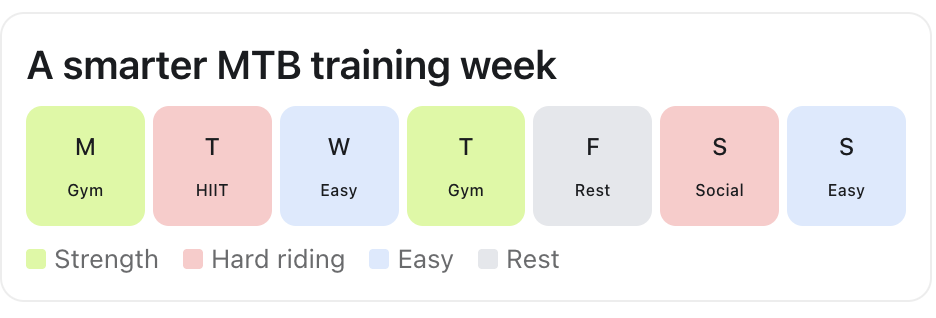
Imagine your week looks like this:
Day | Training |
|---|---|
Monday | Strength training |
Tuesday | Structured bike intervals |
Wednesday | Easy aerobic ride or recovery |
Thursday | Strength training |
Friday | Rest or short easy ride |
Saturday | Social MTB ride — potentially hard |
Sunday | Recovery or easy aerobic activity |
This isn't a universal schedule.
It's an example of how we can make room for meaningful strength work, structured intensity and the riding you actually enjoy.
If Saturday's ride turns out to be much harder than expected, we account for that when planning the next few days.
Your training program should support your life, not compete with it.
7. Be Flexible Without Losing Consistency
One of the biggest advantages experienced athletes have is the ability to follow a plan.
But following a plan doesn't mean blindly completing every workout exactly as written.
Sometimes you need to take a day off.
Sometimes you need to move your intervals.
Sometimes you need to reduce the volume of a gym session because your recovery isn't where you expected it to be.
That's not a failure.
That's good training management.
The distinction I make is between an occasional adjustment and a recurring problem.
If you need an extra recovery day once in a while, take it.
If you need extra recovery days every week, let's look at the program.
Maybe the volume is too high. Maybe we're stacking too many hard sessions together. Maybe sleep, nutrition or other life stressors need more attention.
Whatever the cause, we need to find a training load you can consistently recover from.
Because consistency is where the long-term results come from.
Train Smarter, Not Easier
I don't coach female mountain bikers over 40 by lowering expectations.
I want them strong.
I want them powerful.
I want them confident on their bikes, capable of riding challenging terrain and excited about what they're still able to achieve.
But I also want their training to be purposeful.
That means choosing the right stimulus, measuring progress, respecting recovery and being flexible when life doesn't go according to plan.
You don't need to outwork the changes in your body.
You need to understand how your body is responding and train accordingly.
Your best riding years don't have to be behind you.
And getting older certainly isn't a reason to stop trying to improve.
Want to Find Out What Your Training Is Missing?
My MTB Strength Assessment helps identify the physical qualities that may be limiting your riding and where your training should focus next.
Get stronger. Ride better. Keep progressing.