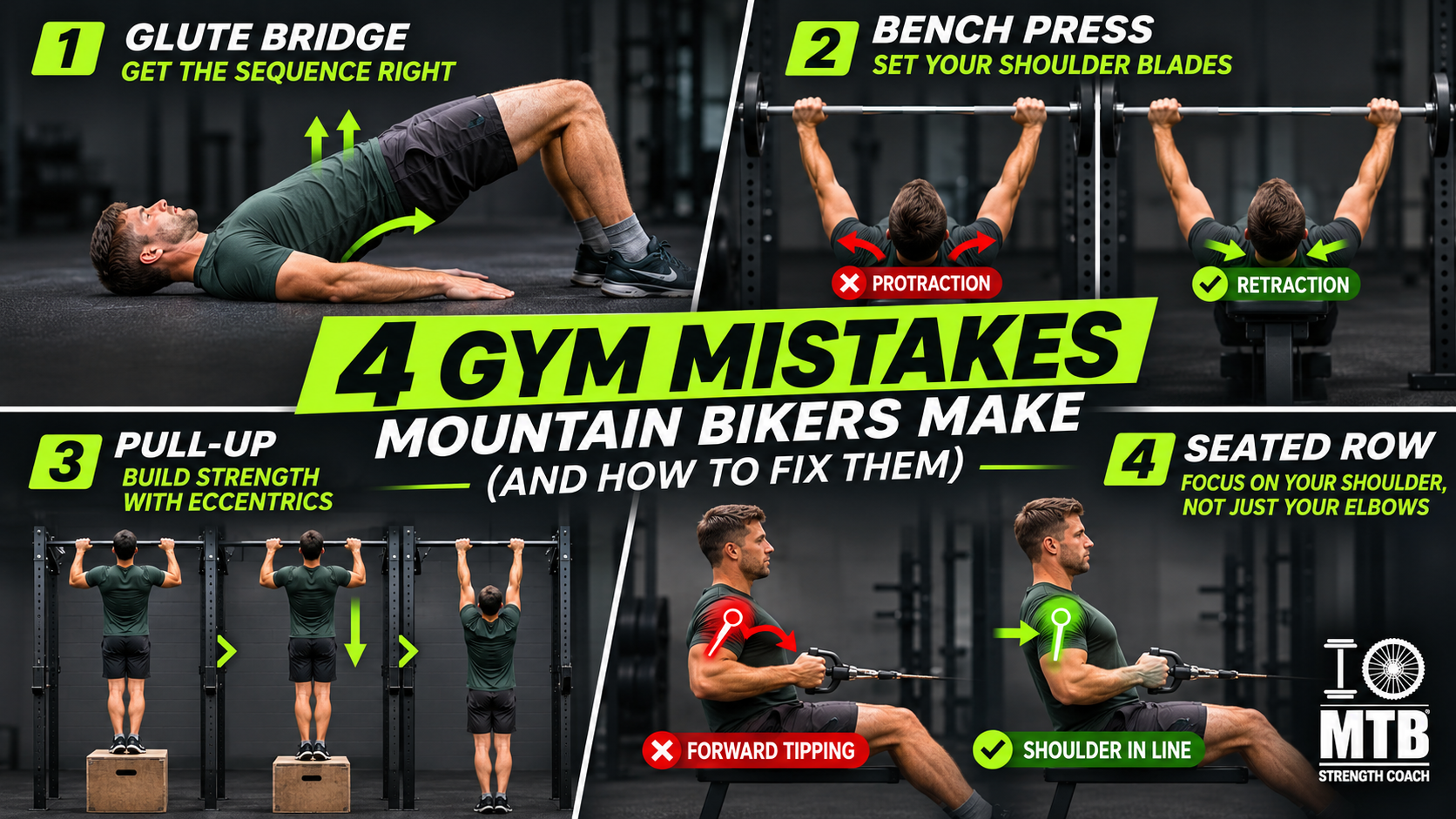
4 Strength Training Mistakes I Keep Fixing With Mountain Bikers
Can't feel your glutes or chest working? Struggling to progress your pull-ups? Getting irritated shoulders or elbows during gym training? These four corrections could make a big difference.
I spend a surprising amount of time correcting exercises that my mountain biking clients have already been doing for years.
Often, the exercise itself is fine.
It's how they're performing it that's holding them back.
A glute bridge where the lower back does too much work. A bench press where the shoulders never feel stable. Pull-ups that never progress beyond the assisted machine. Rows that leave the front of the shoulders or elbows irritated.
Sometimes the solution isn't a different exercise, a lighter weight or another mobility drill.
It's learning how to perform the movement properly.
Here are four of the most common corrections I make when coaching mountain bikers, and how you can apply them in your next gym session.
1. Can't Feel Your Glutes During a Glute Bridge? Start With Your Pelvis
"I do glute bridges, but I never really feel my glutes working."
I hear this all the time.
The glutes are powerful hip extensors, but to use them effectively, you need to be able to control your pelvis and stabilize your spine.
If you simply drive your hips upward and arch your lower back, you can create the appearance of hip extension without getting as much movement from the hips as intended.
The first thing I teach is a supine pelvic tilt.
Lie on your back with your knees bent and feet flat. Gently roll your pelvis backward, bringing your lower back toward the floor. Learn to control that movement without relying on your legs.
Once you've got it, we're going to turn it into a sacro-lumbar curl glute bridge.
The fix: Peel your tailbone off the floor first
Lie on your back with your knees bent, feet planted and head resting on the floor.
Begin with a posterior pelvic tilt, gently bringing your lower back toward the floor.
Peel your tailbone off the floor before your lower back.
Continue lifting through the hips, allowing the pelvis and lower trunk to roll upward in sequence.
Squeeze your glutes at the top without flaring your ribs or forcing your lower back into extension.
Lower slowly and reverse the movement with control.
The order matters.
Rather than throwing your hips into the air and extending through your lumbar spine, you're initiating the movement with pelvic control and allowing the glutes to drive the hip extension.
My coaching cue: "Peel your tailbone off the floor before your lower back."
Get the sequence right, and I bet you'll feel your glutes light up at the top.
Don't chase maximum bridge height. Chase control and a strong glute contraction.
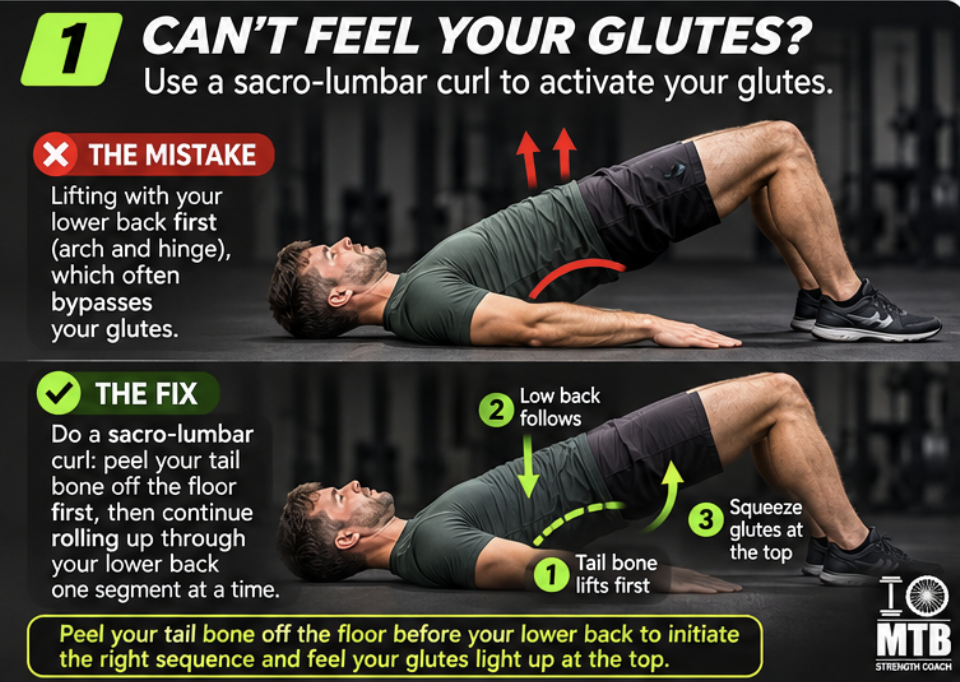
Exercise demonstration: Supine pelvic tilt and sacro-lumbar curl glute bridge.
2. Shoulders or Elbows Hurt During Bench Press? Set Your Shoulder Blades
"My shoulders hurt when I bench press."
Or:
"I never really feel my chest working."
One of the first things I check is what the shoulder blades are doing.
Your chest muscles produce force through your upper arms, but a stable upper back gives you a better foundation for pressing.
When your shoulder blades slide forward and apart as you press, you're losing the retracted position we're trying to maintain during a conventional barbell bench press.
The fix: Learn protraction versus retraction with straight arms
Lie on the bench and hold the bar above your chest with your arms fully extended.
Before you start pressing, compare two positions.
Position 1 — Protraction
With your elbows straight, reach your shoulders toward the ceiling.
Your shoulder blades spread apart and your shoulders move forward around your rib cage.
That's the position we're trying to avoid during this bench press setup.
Position 2 — Retraction
Still keeping your elbows straight, squeeze your shoulder blades together.
You'll feel your upper back become more firmly positioned against the bench. Your middle back may arch slightly away from the bench, and that's okay.
Now keep your shoulder blades retracted as you lower and press the bar.
Don't let them spread apart as you reach the top of the repetition.
My coaching cue: "Pinch your shoulder blades together. Now press without letting them move apart."
Many riders immediately feel a stronger chest contraction and greater control of the weight.
If poor shoulder positioning is contributing to irritation, improving that stability may also make pressing more comfortable.
This is a setup for conventional bench pressing, not a rule that your shoulder blades should remain fixed during every pushing exercise. Persistent shoulder or elbow pain needs individual assessment.
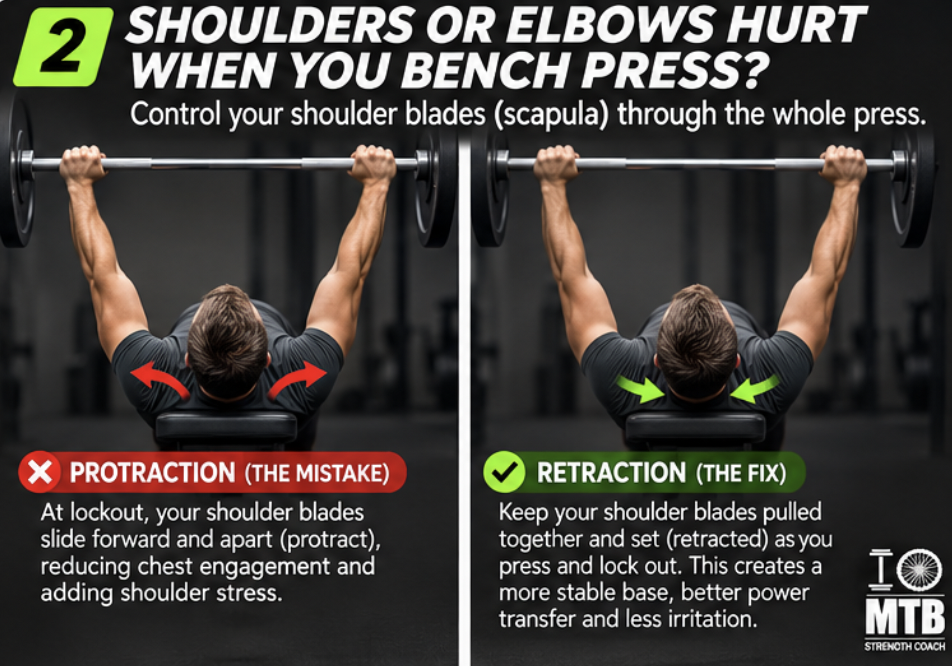
Exercise demonstration: Straight-arm protraction versus retraction, followed by bench press.
3. Can't Do a Pull-Up? Practice the Part You Can Control
How do you practice pull-ups when you can't actually do one?
Perhaps you've been stuck on assisted pull-ups for months. You can complete repetitions with assistance, but every time you try to lift your full bodyweight, you get nowhere.
Here's a progression I regularly use.
Let yourself experience full bodyweight, but only during the lowering phase.
Muscles can generally produce greater force during eccentric contractions, when they're lengthening under load, than during concentric contractions, when they're shortening.
We can use that difference to build pull-up strength.
The fix: Eccentric-only pull-ups
Place a sturdy box beneath the pull-up bar.
Use your legs to get into the top position, with your chin above the bar.
Take your feet off the box and support your full bodyweight.
Lower yourself slowly, aiming for approximately 3–5 seconds.
Continue until both arms are straight, provided you can control the full range comfortably.
Step back onto the box and repeat.
Don't waste energy trying to pull yourself back up between repetitions.
Use your legs to get to the top, then make the lowering phase count.
Start with 2–4 quality repetitions per set. If you can't control your full bodyweight, use some assistance until you can.
My coaching cue: "Cheat your way up. Earn your way down."
Over time, build control through the entire lowering phase, then start working toward full unassisted repetitions.
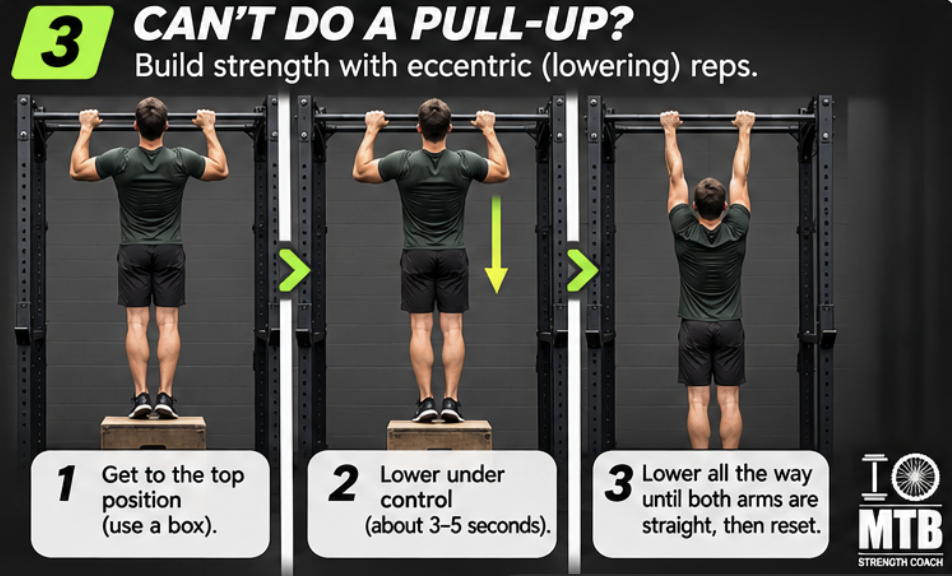
Exercise demonstration: Box-assisted setup and controlled eccentric pull-up.
4. Shoulder or Elbow Pain During Rows? Watch Your Humeral Head
"Rows always seem to bother the front of my shoulder."
Or:
"I feel pulling exercises more in my elbows than my back."
When I watch these riders perform a seated row, they're often concentrating on pulling their elbows as far behind their bodies as possible.
But elbow travel doesn't necessarily tell us whether the shoulder blades are retracting effectively.
And if you're chasing more range by allowing the shoulder to roll forward, you may be creating unnecessary irritation around the front of the joint.
The fix: Focus on the top of your upper-arm bone
The humeral head is the ball at the top of your upper-arm bone, where it meets your shoulder socket.
During a row, I want you to pay attention to the position and movement of this part of the shoulder rather than simply how far back your elbows travel.
Start with your arms extended and your trunk stable.
As you pull:
Begin drawing your shoulder blades backward.
Think about moving the top of your upper arms backward as the shoulder blades retract.
Allow your elbows to follow naturally.
Keep your chest tall without leaning backward to create extra movement.
Stop before your shoulders roll forward, shrug or lose their stable position.
What does the mistake look like?
Watch the front of the shoulder as the rider finishes the pull.
Instead of the shoulder blade moving backward with the upper arm, the shoulder can roll forward and the humeral head may appear to tip toward the front.
That's the movement pattern I want to correct.
We're not trying to force the humeral head backward inside its socket. We're using the visible position of the upper arm and shoulder to help identify better scapular control.
My coaching cue: "Watch your shoulder, not your elbow."
When you get the movement right, you should feel more controlled work through the muscles of your upper back.
Improving that control can also reduce unnecessary loading around the front of the shoulder, including the long-head biceps tendon, when poor mechanics are contributing to symptoms.
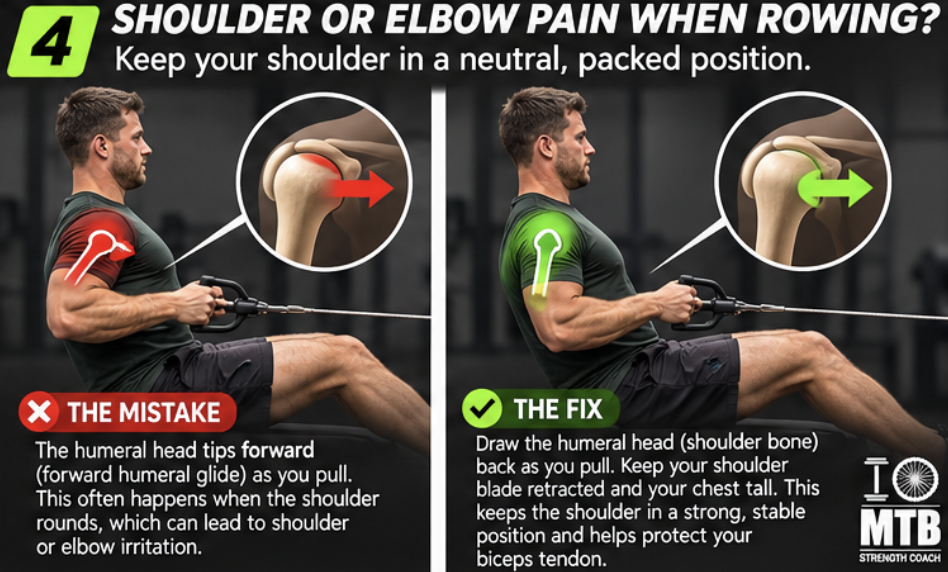
Exercise demonstration: Seated row with forward shoulder tipping versus controlled scapular retraction.
What Do These Four Corrections Have in Common?
There's a theme running through these exercises.
Control the foundation before you try to produce more force.
In the glute bridge, we establish pelvic control so the hips can extend without relying excessively on lumbar extension.
In the bench press, we establish a stable upper back so the chest and arms can press effectively.
In the pull-up, we develop the strength to control our full bodyweight before expecting to lift it.
And in the seated row, we coordinate the shoulder blades and upper arms instead of chasing extra elbow movement.
None of this requires complicated equipment or a completely different training program.
Sometimes, a small technical correction makes an exercise feel entirely different.
And once you're getting the intended stimulus from your training, it's much easier to progress your strength consistently.
Better Strength Training Makes for Better Mountain Biking
Mountain bikers don't have unlimited training time.
Between riding, work, family and everything else, most of us need to get as much as possible from the gym sessions we can fit in.
That means choosing appropriate exercises, progressing them intelligently and making sure we're actually training the qualities we intended.
It also means paying attention when something doesn't feel right.
Recurring shoulder pain, irritated elbows or a lower back that always takes over during glute exercises shouldn't simply be accepted as the cost of getting stronger.
Sometimes the solution is surprisingly simple.
Before changing the exercise, make sure you're doing it well.
Not Sure What's Holding Back Your Riding?
My MTB Strength Assessment helps you identify the physical qualities that deserve attention so you can train with more purpose.
Get stronger. Move better. Ride better.