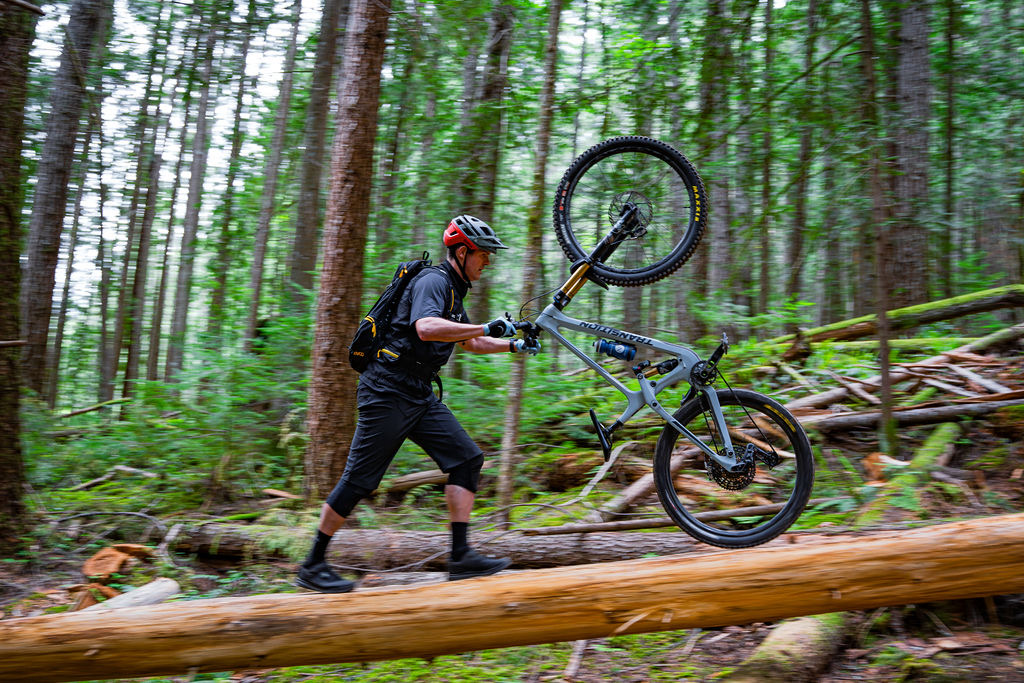
Week 1 of my 2027 Squamish Enduro preparation. I’m sharing my free MTB off-season training plan, the workouts, and the coaching decisions behind them.
My first week of off-season training went almost suspiciously well.
No smashed legs. No workouts I struggled to recover from. No feeling like I needed another day in the week to fit everything in.
I felt strong, capable, and ready to train all week.
As a strength and conditioning coach for mountain bikers, that’s exactly what I want to see.
I’m going to share my training over the coming months, including my weekly schedule, interval workouts, strength targets, and how I progress them towards race day.
You can follow along and borrow whatever is useful.
But there’s something more valuable than copying my workouts: understanding why I chose them, and why your ideal MTB training program might look completely different.
Week 1: Finding the Training Sweet Spot
I’m genuinely delighted with how the first week went.
The time commitment was manageable, the intensity felt right, and my body felt great.
As a coach, finding this sweet spot with an athlete is one of the most satisfying parts of my job.
We’re providing enough training stimulus to drive improvements without creating so much fatigue that recovery becomes a constant battle.
And it doesn’t always happen so flawlessly in Week 1!
Sometimes we discover that the training volume is too ambitious, certain workouts create unexpected fatigue, or the schedule doesn’t quite fit.
That’s useful feedback. We adjust.
In my case, things landed pretty close to perfect straight away.
One successful week doesn’t prove the program is perfect, but it’s a great starting point.
Training Through a Squamish Winter
It’s November in Squamish. Cold, wet, and not particularly inviting outside.
I’m also waiting for my new e-bike to arrive, and convincing my little guy to come riding in miserable weather isn’t always easy!
Yesterday was a perfect example of why I’ve built flexibility into the program.
I had two options planned: an outdoor ride or an indoor alternative.
Had the new bike arrived, I’d probably have been out riding.
Instead, I spun in the garage and spent some time strengthening my longstanding Achilles issue.
I was perfectly happy with that decision.
The indoor bike isn’t replacing mountain biking. It’s a convenient Plan B when outdoor riding isn’t practical.
I’ll ride trails whenever possible, but most winter weeks will need indoor and outdoor options.
That’s the difference between following a training plan and understanding one.
If a workout needs to change, I need to understand what it was supposed to achieve.
An aerobic ride can often be replaced indoors. Technical descending practice can’t.
What Am I Actually Training For?
My target is the Squamish Enduro on May 2, 2027.
Rather than simply deciding I need more fitness, I’ve used my own MTB climbing tests to identify where I have the greatest opportunities for improvement.
The conclusion?
My sustained climbing fitness is reasonable, but there’s room to improve my higher-intensity aerobic performance, my ability to repeat hard efforts, and my durability later in a ride.
I want to work harder, repeat that work, and maintain performance after hours on the bike.
If you’re curious about how climbing strengths and weaknesses differ between riders, I’ve explored that in What Kind of Climber Are You?.
The interesting programming question is how to improve those qualities without trying to train everything at once.
My Free MTB Off-Season Training Schedule
Here’s my current weekly plan.
Monday — Recovery and Mobility
Recovery, physical maintenance, hip mobility, and Achilles strengthening where appropriate.
Tuesday — MTB Breakfast Club Strength
Heavy strength training, including squats, hinges, pressing, pulling, and supporting exercises.
Wednesday — Threshold Climbing Intervals
Controlled, sustained climbing efforts. Outdoor when possible, indoor when necessary.
Thursday — MTB Breakfast Club Strength
Second structured strength session, progressing our main lifts.
Friday — Easy Aerobic Ride or Recovery
Flexible aerobic work depending on fatigue and recovery.
Saturday — Mountain Bike Ride
Trail riding, climbing, or technical work depending on the conditions and training priorities.
Sunday — Longer Aerobic or E-Bike Ride
Endurance and durability development, with family riding and indoor alternatives when appropriate.
This is a framework, not a rigid calendar.
The priority is two productive strength sessions and consistent riding, with enough flexibility to manage weather, family, work, and recovery.
Here’s why I’ve chosen this structure.
Strength Training: Aiming for Another 10%
As you might expect from a guy whose business is MTB Strength Coach, my strength base is pretty good!
But there’s still room for improvement.
My goal is to increase my main strength numbers by approximately 10% between now and February.
That’s ambitious for an experienced lifter, but it’s something worth pursuing.
If I can increase strength without unnecessarily adding body weight, I improve my relative strength.
That potentially gives me greater force-producing capacity for accelerating, climbing, absorbing impacts, and controlling the bike through demanding terrain.
Of course, increased gym strength doesn’t automatically mean more watts on the bike. I still need to apply that strength through riding.
We’re currently increasing lifting intensity in Breakfast Club, moving into heavier strength work.
Why only twice per week?
Because I already have a reasonable strength base. Two productive sessions should provide a useful stimulus while preserving recovery capacity for cycling.
A rider who needs to build more muscle or has a significant strength deficit might benefit from more strength-training exposure.
It depends on their starting point and goals.
The Individual Stuff That Matters
I’ve also got some less glamorous things to work on.
My hip mobility needs attention, and I’ve got a longstanding Achilles problem that deserves consistent strengthening.
I’ll pepper this work throughout the week, often around rides, rather than creating a series of additional full workouts.
A little mobility here, some appropriate Achilles loading there, and sensible management of my back during gym sessions.
These might seem like minor details, but they’re important for keeping me training consistently.
Good programming addresses the limitations of the athlete, not just the demands of their sport.
Why I’m Starting With Threshold Instead of VO2 Max
My climbing tests suggest improving high-intensity aerobic performance should be a priority.
So why not jump straight into brutal VO2 max intervals?
Because I’m already increasing my strength-training intensity.
Turning up two demanding training dials simultaneously can be risky.
Heavy lifting creates fatigue. High-intensity cycling creates fatigue.
If I aggressively increase both at once, I risk compromising workout quality and recovery.
And remember, Week 1 felt fantastic. I want to preserve that balance.
Threshold-focused intervals provide a controlled introduction to more demanding cycling.
They’re still challenging, but I can manage the intensity and total workload without immediately introducing repeated near-maximal aerobic efforts.
It’s a useful starting point while I adapt to heavier lifting.
This Week’s MTB Climbing Workout: 3 × 8 Minutes
Here’s Wednesday’s session.
Warm-up: 10–15 minutes of gradually increasing intensity.
Main workout: 3 × 8 minutes at a controlled, hard effort around threshold.
Recovery: 3–4 minutes of easy pedalling between intervals.
Cool-down: 5–10 minutes easy.
Total time: approximately 45–55 minutes.
The goal is three consistent efforts, not going so hard on the first that the others fall apart.
Outdoor option: Find a sustained climb where you can maintain a reasonably steady effort for eight minutes.
Indoor option: Complete the same session on a stationary bike or trainer.
Why eight minutes?
It’s a manageable starting point that gives me 24 minutes of quality work.
As I adapt, I can progress towards longer intervals, potentially 3 × 10 minutes or more.
But only when I’m maintaining the intended intensity and recovering well.
The goal is to introduce enough training to improve without losing the balance I established in Week 1.
Endurance: Learning to Keep Performing
My durability testing highlighted another opportunity.
I want to maintain more of my performance after accumulating significant riding time.
That’s why longer aerobic rides remain part of the plan.
Initially, I’m aiming for consistent, manageable endurance riding rather than massive efforts that compromise the following week.
Not every ride needs to be hard.
As my capacity develops, I’ll look at introducing harder efforts after accumulated riding time.
For now, consistency is more important than heroics.
What About the New E-Bike?
I’m particularly excited about adding an e-bike to the program.
I’ll reveal the bike itself when it arrives!
One of my objectives is to accumulate more quality descending time without every session requiring a demanding climb.
Motor assistance gives me another way to manage training load.
I can reduce climbing fatigue during descending-focused sessions, complete more technical laps, or adjust assistance when I want a greater aerobic challenge.
An e-bike doesn’t automatically make a workout easy. The demand depends on how you ride it.
I’ll be experimenting with different approaches and sharing what works.
Why I’m Not Training Everything Right Now
Different physical qualities develop at different rates.
Strength and aerobic endurance can benefit from months of progressive training.
Other qualities, such as short-duration explosive power, can respond relatively quickly to focused work.
Meaningful sprint improvements can occur within four to six weeks, although that isn’t a universal ceiling.
We’re still over five months from race day.
There’s little point prioritizing alactic sprint work right now when I have other qualities that need longer-term attention.
Especially when I’m already increasing my strength-training demands.
The objective isn’t to train everything simultaneously. It’s to develop the right qualities at the right time.
I’ll explain how those priorities evolve in future articles.
Why Copying My Training Plan Might Be a Mistake
Here’s the most important coaching lesson in this article.
You can absolutely copy my weekly schedule.
In fact, plenty of riders would probably benefit from something similar.
But think about how I arrived at it.
I tested my climbing fitness to identify opportunities for improvement.
I chose threshold training before more demanding intervals because I’m simultaneously increasing strength intensity.
I set a strength goal based on my existing capabilities.
I included endurance riding to address durability.
I added hip mobility and Achilles strengthening because my body needs them.
And I built indoor and outdoor alternatives around my actual life.
That’s a lot of individual decision-making behind a fairly simple-looking plan.
Your limitations might be completely different.
Maybe you need more strength. Maybe you’re already strong enough but struggle to sustain your climbing performance. Maybe fatigue ruins your descending later in a ride.
Or maybe your biggest challenge is fitting productive training around a busy life.
What Should YOU Be Training This Winter?
That’s exactly why I created my free MTB Fitness Assessment.
Rather than guessing which workouts to copy, start by identifying your own strengths and limitations.
Find your starting point with my free MTB Fitness Assessment.
And if you want the complete program designed, monitored, and adjusted around your goals, that’s what my individual MTB Performance Coaching is for.
The difference isn’t simply having access to better exercises.
It’s knowing what to train, how much to train, and when to make adjustments.
Want to Join Me at MTB Breakfast Club?
If the strength-training component appeals to you, you’re welcome to join us at MTB Breakfast Club.
We’re following structured strength training blocks designed for mountain bikers.
And importantly, you don’t have to join at the beginning of a block.
We’ll decide together where you should start.
That might mean joining the current phase or spending some time developing foundational strength, movement quality, or work capacity first.
There’s no point throwing someone straight into today’s heavy workout if it isn’t the right starting point.
Explore MTB Breakfast Club and get in touch about joining.
Week 2: Can I Keep the Sweet Spot?
This week is largely rinse and repeat.
Two strength sessions, threshold climbing intervals, aerobic riding, and ongoing attention to my mobility and Achilles.
Hopefully, the new e-bike will arrive soon.
But whether I’m riding trails or spinning in the garage, the objective remains the same.
Build the fitness I need without creating more fatigue than I can recover from.
Some weeks will go perfectly. Others will involve wet weather, competing priorities, and a little improvisation.
That’s normal.
The best training program isn’t the one that leaves you exhausted. It’s the one that consistently makes you better while fitting into the life you actually have.
Week 1 set a great standard.
Now let’s see if I can keep building on it.