A lot of mountain bikers treat a sore lower back as part of the sport.
Long ride? Tight back.
Big climbing day? Stiff back.
Long descent? Aching back.
Getting older? Must be normal.
I don’t buy it.
Back pain might be common in mountain biking. That doesn’t make it normal.
In fact, virtually every significant back rehab program I’ve delivered has had a similar story behind it: years of tightness, stiffness or recurring discomfort that the rider had accepted as “just part of riding.”
Until it wasn’t.
The symptoms became more frequent. The pain lasted longer. Maybe it started affecting normal life. Sometimes symptoms started travelling into the glute or leg.
That’s when something that might once have been relatively straightforward to address can become a much bigger problem.
So if your back regularly hurts when you ride, don’t just learn to live with it.
Deal with it before it gets worse.
Start With the Hinge
When a mountain biker comes to me complaining of lower-back pain, one of the first things I want to see is how they hinge.
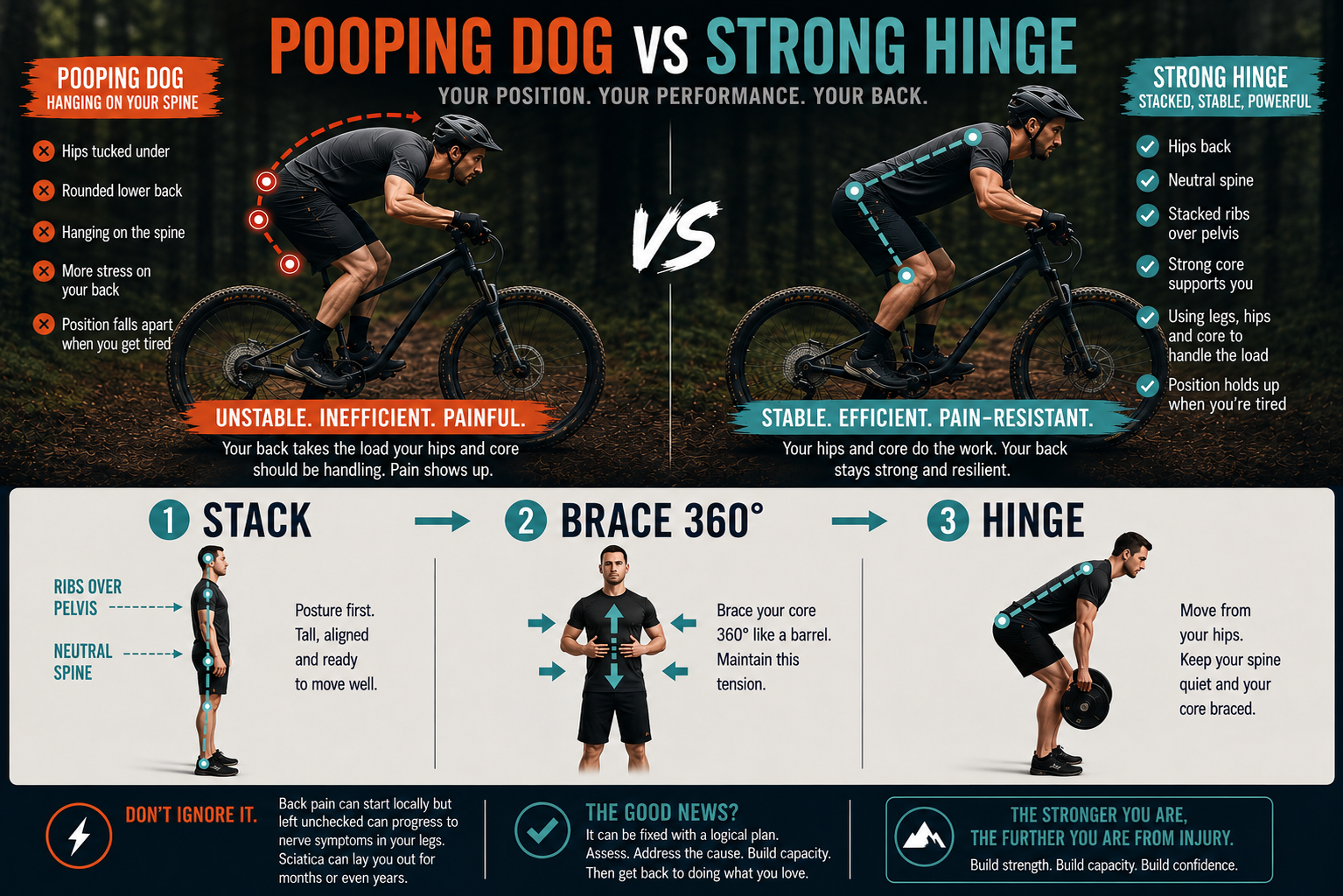
And on the bike, I’m looking for something I affectionately call “pooping dog posture.”
You probably know exactly what I mean.
The pelvis tucks underneath. The lower back rounds. The rider collapses through the middle and ends up hanging on their spine rather than supporting the position with their hips and trunk.
Some riders spend most of their time there.
Others look pretty good when they’re fresh but gradually collapse into it as they get tired.
That’s an important distinction.
If you can achieve a good position when you’re fresh but lose it two hours into a ride, you might not have a mobility problem.
You might have a capacity problem.
The Goal Isn’t a Perfectly Straight Back
I don’t want mountain bikers becoming afraid of spinal movement.
Your spine is supposed to move.
Nor do I want you riding around rigidly trying to maintain some imaginary “perfect posture.”
The goal is to have options.
Your hips and thoracic spine need enough movement to allow you to get into the positions mountain biking requires.
Your trunk needs enough strength and control to create stability when required.
And your hips need to be able to produce force from that stable platform.
That’s the relationship we’re after:
Stable trunk. Moving hips.
Or even simpler:
Stack. Brace. Hinge.
First, Build the Core
“Strengthen your core” is probably one of the most overused pieces of advice in back rehab.
But that doesn’t mean it’s wrong.
It just needs some context.
I’m not interested in giving you hundreds of crunches or trying to make your spine permanently rigid.
I want you to learn how to create a strong, stable cylinder through your trunk — and then maintain that stability while your arms, legs and eventually your hips move around it.
Two very simple exercises are great for teaching this:
Dead bugs and glute bridges.
They aren’t flashy.
They aren’t particularly “MTB-specific.”
They don’t need to be.
We’re building the healthy human first.
Dead Bugs: Learn to Control the Cylinder
A good dead bug teaches you to move your limbs while maintaining control through your trunk.
Think about your torso as a cylinder.
Your ribcage sits above your pelvis.
Rather than sucking your stomach in or aggressively flattening your back, create pressure around that entire cylinder — front, sides and back.
That’s your 360-degree brace.
Now maintain it while the arms and legs move.
Watch the dead bug exercise demo here.
This is the foundation for what comes next.
Now Let the Hips Move
Once we can create trunk stability, we can start applying it to hip extension.
This is where the glute bridge becomes really useful.
I’ll often have someone perform a bridge and ask:
“Where do you feel that?”
A surprising number of people point at their lower back or hamstrings.
So we change the strategy.
Stack the bottom ribs over the pelvis.
Create the 360-degree brace.
Maintain that position.
Now extend the hips.
And suddenly:
“Ohhh… THAT’S my glutes.”
For a lot of people, the difference is like a lightbulb going off.
Their glutes weren’t necessarily “switched off.”
We created a more stable platform from which the hips could extend.
And once the spine is stable, the glutes can do a much better job of producing the hip extension we’re looking for.
Watch the glute bridge demonstration here.
Stable Core → Hip Extension → Hinge
Now we can take that same idea into a standing position.
This is where the Romanian deadlift becomes one of my favourite exercises for mountain bikers.
Not because an RDL somehow mimics riding.
It doesn’t.
It’s useful because it teaches you to maintain a stable trunk while producing movement and force through the hips.
Start tall.
Stack your bottom ribs over your pelvis.
Brace 360 degrees.
Soften the knees.
Push the hips backwards while maintaining the stack.
Then use the hips to return to standing.
Watch the Romanian deadlift demo here.
Once that pattern is solid, the kickstand RDL is a great progression.
Now we’re shifting more of the work toward one hip while asking you to maintain control of the trunk and pelvis.
Again, we’re not trying to imitate mountain biking in the gym.
We’re building the physical qualities that mountain biking requires.
Watch the kickstand RDL demonstration here.
Don’t Lose the Stack
There’s another compensation I see all the time.
Someone learns to hinge but loses their trunk position by overextending through the spine.
The chest comes up.
The lower back arches.
And, importantly, the bottom ribs flare forwards and away from the pelvis.
When that happens, you lose tension through the front of the cylinder and your ability to create a strong 360-degree brace decreases.
You might still look like you’re hinging.
But you’ve lost the stable platform we were trying to create.
So think:
Ribs stacked over pelvis → brace 360° → hips move.
Not:
Chest up → ribs flare → lower back arches → hips move.
This is another reason I like dead bugs and glute bridges early in the process.
They teach you what it feels like to keep the ribcage and pelvis connected before we ask you to maintain that relationship during a loaded hinge.
Then we progressively add load.
Now Look at Yourself on the Bike
Here’s something I’d encourage almost every mountain biker with recurring back pain to do:
Get some video of yourself riding.
Look at yourself:
seated and pedalling
standing and pedalling
descending
when you’re fresh
when you’re tired
You might be surprised.
What you think you’re doing and what you’re actually doing can be very different.
Pay particular attention to what happens as you fatigue.
Do the hips stay available?
Can you maintain the hinge?
Or does the pelvis start tucking underneath you as your lower back rounds and you gradually fall into the pooping-dog position?
If your position looks good when you’re fresh but falls apart when you’re tired, that’s valuable information.
You may not need to stretch more.
You may need to become strong enough to hold your position for longer.
Your Hips and Thoracic Spine Still Need to Move
The classic joint-by-joint approach is useful here.
We want adequate movement available through the hips and thoracic spine, combined with the ability to create appropriate control through the trunk.
If your hips can’t access the movement required to hinge, your body still has to find that movement somewhere.
Often, the lower back contributes more than we’d like.
The same can happen when the thoracic spine is extremely restricted.
Stop accepting back pain as the price of admission for a good ride. Build your trunk capacity, sort out your hinge, and give your engine the support it needs. If you want a structured plan to get your body trail-ready, check out our strength programs at MTB Strength Coach.