Mountain Bike Strength Training | Climbing Performance | Injury Prevention
You’re halfway up a climb.Legs feel okay. Breathing is under control.
But your lower back is on fire.
You shift around, stand up, sit back down…Nothing really fixes it.
So what’s going on?
First — It’s (Probably) Not Your Bike Fit
Let’s address the obvious.
Yes, bike fit matters.But it’s rarely the real reason your lower back is blowing up on climbs.
Mountain biking isn’t static.
You’re:
- Moving constantly
- Adjusting to terrain
- Shifting position
- Absorbing impacts
Moving constantly
Adjusting to terrain
Shifting position
Absorbing impacts
A “perfect” static bike fit doesn’t fix a dynamic movement problem.
This is something I see often:
Riders assume a new bike or small setup change will solve it.It usually doesn’t.
Could bike fit contribute? Yes.Is it the root cause for most riders? No.
The Real Problem: Your Lower Back Is Overworking
Your lower back should:
- Stabilize
- Transfer force
- Hold position
Stabilize
Transfer force
Hold position
Not generate power.
When other areas aren’t doing their job, your back takes over.
1. Your Glutes Aren’t Doing Enough
If your glutes aren’t contributing:
- You lose power through the pedals
- Your hips drift out of position
- Your lower back starts compensating
You lose power through the pedals
Your hips drift out of position
Your lower back starts compensating
Result: back fatigue and early burnout.
Focus on:
- Glut Bridge - learn to do these right and you'll finally be able to feel your glutes working.
Glut Bridge - learn to do these right and you'll finally be able to feel your glutes working.
2. You Don’t Have Real Trunk Control
This isn’t about visible abs.
It’s about your ability to:
- Hold position under load
- Resist unwanted movement
- Transfer force efficiently
Hold position under load
Resist unwanted movement
Transfer force efficiently
If you can’t do that, your spine starts moving instead of stabilizing.
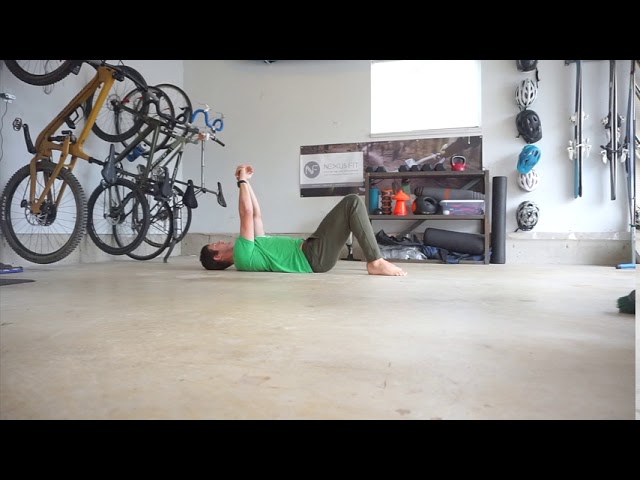
Video: Core Control(Insert your YouTube core video here)
Focus on:
- Quadruped Shuolder taps
Quadruped Shuolder taps
3. You Can’t Hinge Properly
If you don’t have a clean hip hinge:
- You can’t get into a strong climbing position
- You rely on spinal movement
- Your back takes on more load than it should
You can’t get into a strong climbing position
You rely on spinal movement
Your back takes on more load than it should
Result: overload and fatigue.
Video: Hip Hinge(Insert your YouTube hinge video here)
Start with:
- Hinge & Reach
Hinge & Reach
Key cue:“Brace your abs to match the tension in your lower back:"
4. Your Climbing Position Breaks Down
Even strong riders run into this.
If you’re:
- Too upright
- Hanging off your lower back
- Pulling instead of driving through the pedals
Too upright
Hanging off your lower back
Pulling instead of driving through the pedals
Your back becomes the primary driver.
Climbing Position — “Piano Hands”
A useful concept I got from a great coach and friend - Jake Johnstone.
The idea is simple:
- Light hands
- Stable upper body
- Weight driven through the pedals
- Controlled hinge rather than spinal collapse
Light hands
Stable upper body
Weight driven through the pedals
Controlled hinge rather than spinal collapse
Why It Shows Up on Climbs
Climbing exposes inefficiencies.
There’s:
- Higher Torque demand
- No Coasting
- No reset
- No momentum to mask issues
Higher Torque demand
No Coasting
No reset
No momentum to mask issues
Whatever isn’t working becomes obvious quickly.
The Mistake Most Riders Make
They feel back pain and assume:
“I need to stretch my back more”or“I need a bike fit”
Those can help temporarily.
But if the underlying issue isn’t addressed, the problem returns.
What Actually Fixes It
You don’t need:
- A new bike
- A different saddle
- More random mobility work
A new bike
A different saddle
More random mobility work
You need:
- A satble trunk
- Strong Glutes
- A clean hinge
- A better climbing position
A satble trunk
Strong Glutes
A clean hinge
A better climbing position
What This Means for Your Training
If your lower back is blowing up on climbs:
You’re not lacking effort.You’re leaking force.
Fix that, and you’ll:
- Climb longer
- Produce more consistent power
- Stop thinking about your back entirely
Climb longer
Produce more consistent power
Stop thinking about your back entirely
When This Isn’t Just a Training Issue
For some riders, this goes beyond fatigue.
It becomes:
- Recurring lower back pain
- Flare-ups after longer rides
- Hesitation on steep or sustained efforts
- A lack of confidence in the body
Recurring lower back pain
Flare-ups after longer rides
Hesitation on steep or sustained efforts
A lack of confidence in the body
At that point, general training isn’t enough.
A Higher Level of Support
This is why I’m developing a more hands-on coaching option for riders dealing with these issues.
This goes beyond standard programming and includes:
- Movement assessment specific to riding
- Integration of strength and rehab
- Video feedback (gym and on the bike)
- Ongoing adjustments based on how your body responds
Movement assessment specific to riding
Integration of strength and rehab
Video feedback (gym and on the bike)
Ongoing adjustments based on how your body responds
Who This Is For
This is for riders who:
- Keep running into the same issue
- Have already tried basic strength work
- Want to ride hard without second-guessing their body
Keep running into the same issue
Have already tried basic strength work
Want to ride hard without second-guessing their body
Why This Matters
You can work around these problems for a while.
But eventually:
- They limit performance
- They reduce consistency
- Or they develop into something more serious
They limit performance
They reduce consistency
Or they develop into something more serious
Addressing it properly allows you to:
- Train consistently
- Push when it matters
- Ride with confidence
Train consistently
Push when it matters
Ride with confidence
Want to Fix This Properly?
Start here:
Take the MTB Fitness Scorecard(Find out what’s actually limiting your riding — strength, endurance, or movement)
TRY IT HERE
If it turns out this is more than a simple training adjustment,I’ll guide you toward the appropriate level of support.
See you on the Trails!