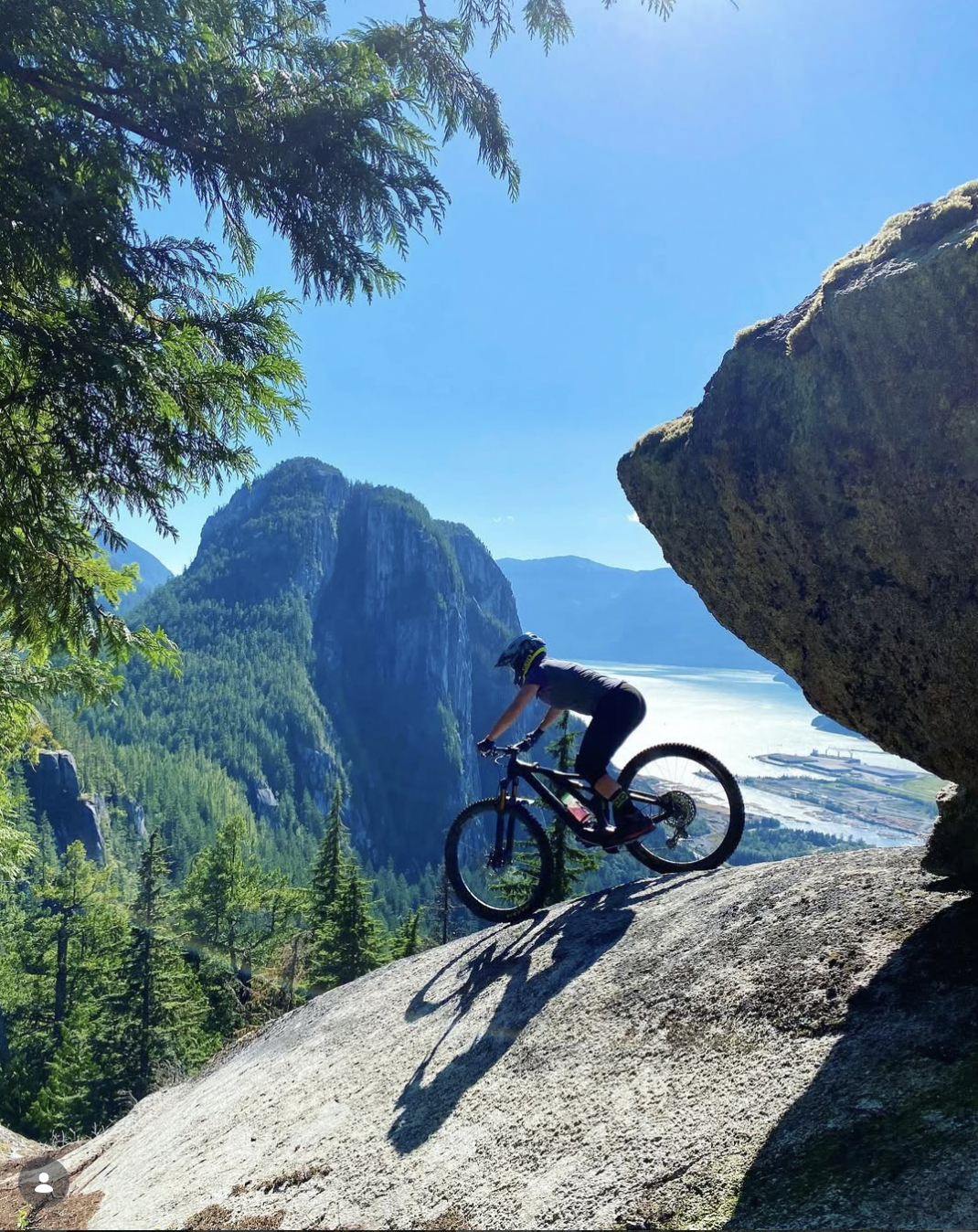
Menopause Doesn't Mean Stop Shredding
And turning 40 definitely doesn't mean your best days on a mountain bike are behind you.
But for a lot of women, somewhere through their 40s the old formula starts working a little less reliably.
A big weekend takes longer to recover from. A bad night's sleep hits harder. You might feel strong one week and strangely flat the next. Perhaps you're noticing more niggles, less pop, or that piling another hard ride onto an already busy week doesn't work like it used to.
And if you're moving through perimenopause or menopause, hormonal changes may be adding another layer to all of this.
The temptation is to assume you're simply getting older and need to start backing off.
I don't think that's the answer.
I've spent more than 20 years coaching strength and conditioning, and my approach with mountain bikers at this stage of life isn't to make everything easier.
It's to make everything more intentional.
You can still ride hard. You can still get stronger. You can still race, hit jumps, tackle big days in the mountains and continue progressing as a rider.
But we need to get better at deciding where to spend your training energy.
Here are the adjustments I'd make.
1. Don't Stop Lifting Heavy
One of the worst responses to getting older is gradually removing everything challenging from your training.
- Lighter weights.
- More reps.
- More cardio.
- Less jumping.
- Less intensity.
Eventually you've created a training program that doesn't ask your body to maintain the very qualities you're worried about losing.
Through your 40s and the menopause transition, maintaining muscle, strength, power and bone health becomes increasingly important.
That makes resistance training more valuable, not less.
For a mountain biker, I'm particularly interested in developing:
- Strong hips and posterior chain
- Good hinge mechanics
- Trunk stiffness and control
- Upper-body pushing and pulling strength
- Unilateral strength
- The ability to produce and absorb force
That doesn't mean constantly testing your max.
Most of the strength work I program isn't anywhere near failure. We want enough load to stimulate adaptation without generating fatigue for the sake of it.
It means using meaningful loads, progressing them appropriately and giving your body a reason to stay strong.
Don't train like you're fragile. Train like you're preparing to ride.
2. Keep Some Intensity
The same thing applies to intensity.
You don't automatically need to replace hard training with endless easy cardio because you've turned 40.
Aerobic work is important. I use plenty of it.
But we also want to preserve the ability to produce power and tolerate high-intensity efforts.
Mountain biking isn't a steady-state sport.
A technical climb can require repeated bursts of power. A descent demands hard efforts separated by brief periods of recovery. Accelerating out of a corner, punching over a feature, sprinting up a steep pitch or popping the bike over an obstacle all require qualities that easy aerobic riding alone won't maintain.
That doesn't mean every ride becomes an interval session.
Quite the opposite.
Make the hard work hard enough to have a purpose — then let the easy work actually be easy.
One of the easiest ways to create unnecessary fatigue is to spend your entire training week somewhere in the middle.
Not hard enough to create a strong training stimulus.
Not easy enough to recover from.
Keep some intensity. Just make it deliberate.
3. Stop Trying to Out-Train Under-Fuelling
This is a big one.
If you want your body to maintain muscle, recover from training and perform on the bike, you need to give it enough energy to do those things.
Protein matters.
Getting enough high-quality protein across the day is an important part of maintaining and building lean mass.
But protein isn't the entire story.
Mountain biking needs carbohydrate.
Long rides need fuel.
Hard training needs fuel.
Recovery needs fuel.
If you're increasing your training while simultaneously trying to eat as little as possible, eventually something has to give.
Sometimes the rider who thinks she has a recovery problem actually has a fuelling problem layered on top of a recovery problem.
And simply adding more training isn't going to fix either.
I'd much rather have an athlete properly fuelled for two excellent strength sessions and three quality rides than under-fuelled while trying to cram seven workouts into the week.
More isn't automatically better.
Adaptation is the goal.
4. Recovery Is Now Part of the Program
This may be the biggest adjustment.
When you're younger, you can get away with some pretty questionable decisions.
- Train hard.
- Sleep five hours.
- Go to work.
- Train again.
- Somehow survive.
Eventually the margin gets smaller.
Add the potential sleep disruption and other symptoms that can accompany perimenopause and menopause, plus jobs, kids, relationships and normal life stress, and recovery capacity can fluctuate significantly.
But this doesn't mean: “I'm tired, therefore I shouldn't train.”
It means we need to become better at adjusting the dose.
Maybe today's heavy strength session becomes slightly shorter.
Maybe an interval ride becomes an aerobic ride.
Maybe we move the hard session 24 hours.
And sometimes you feel fantastic and we absolutely go after it.
This is an important distinction.
The goal isn't to become afraid of fatigue.
It's to recognize that training only works when you can recover from it.
Good programming isn't a spreadsheet that ignores the person doing it.
The program should respond to the athlete.
That's particularly important during this stage of life.
5. Don't Put Every Quality Into Every Workout
This is something I see frequently with busy riders.
They have limited training time, so every workout starts becoming everything:
- Strength.
- Conditioning.
- Core.
- Mobility.
- Intervals.
- Power.
Forty-five minutes later they've done a little bit of everything but not enough of anything to create much adaptation.
I'd rather give each session a job.
A strength session should develop strength.
An aerobic ride should develop aerobic capacity.
A hard ride should contain meaningful intensity.
A recovery day should actually allow you to recover.
This becomes increasingly valuable when recovery isn't unlimited.
One purpose. Enough stimulus to adapt. Then move on.
You don't need to win every workout.
You need the week — and eventually the year — to make sense.
6. Ride Season and Building Season Shouldn't Look the Same
This is especially important for mountain bikers.
Summer is already physically demanding.
You're riding more. You're accumulating descents. You're climbing. You're travelling. You're spending long days outside. Hopefully, you're saying yes to spontaneous rides with friends.
Trying to simultaneously run a high-volume strength-building program often doesn't make sense.
During riding season, my goal is usually: Maintain. Support. Recover. Ride.
We keep enough strength training to hold onto the qualities we've built without burying you in gym fatigue.
But the off-season is different.
That's our opportunity.
When riding volume drops, we have space to deliberately build strength, muscle, power, aerobic capacity, movement options, and tissue tolerance.
Rather than desperately trying to build fitness while simultaneously using it, we can spend a few months raising your physical ceiling.
Then, when riding volume increases again, the emphasis changes.
We maintain what we've built and put that bigger engine and stronger chassis to work on the trail.
Ride season is for riding. Building season is where we prepare for it.
Ready to Train Smarter?
If you're ready to stop guessing with your training and want a structured approach that respects where you're at while pushing your riding forward, check out my strength and conditioning programs designed specifically for mountain bikers.