How to Use the Gym to Look After Your Body During Mountain Bike Season
By this point in the mountain bike season, many riders feel better on the bike than they have all year. You’re riding more often, carrying more speed, and attempting trails, features, or distances that felt intimidating a few months ago. Your fitness is improving, your confidence is high, and you may feel like Superman or Wonder Woman every time you drop into a descent.
But there’s often another change happening quietly in the background. Strength sessions become less consistent. Mobility work disappears. The gym program that felt manageable in spring now competes with long rides, events, travel, work, family commitments, and accumulated fatigue.
Your riding may be progressing while some of the physical qualities supporting it begin to slide. That matters because riding fitness is not the same as overall physical preparedness. You can have the cardiovascular fitness for another lap while gradually losing strength, movement options, joint capacity, and tolerance to the forces created by faster, longer, and more ambitious riding.
The answer is not to force an offseason training plan into the busiest part of summer. The answer is to use the gym differently.
What the Gym Is For During Riding Season
During the offseason, the goal may be to build substantial strength, muscle, power, and work capacity. During peak riding season, the priorities change. The gym should help you:
Maintain force production.
Preserve joint and tissue capacity.
Retain movement through ranges the bike does not provide.
Maintain upper-back, shoulder, and trunk strength.
Keep a small dose of speed and power.
Support recovery between rides.
Arrive at races, events, and priority rides physically prepared.
You may still improve selected lifts or movements, but trying to progress everything at once is rarely realistic when riding volume is high. Maintaining strength while completing more riding is still progress.
Manage the Total Stress of the Week
Every rider has a limited recovery budget. Strength training, trail rides, intervals, racing, work stress, poor sleep, travel, and family commitments all draw from it.
The question is not simply:
Can I fit this workout into my calendar?
The better question is:
Can I recover from this workout while maintaining the quality of my priority riding?
A good in-season program still needs meaningful loading. It just needs the right dose. In our current Breakfast Club block, the main strength work remains challenging enough to maintain force production. During unusually high-volume riding weeks, we reduce the amount of work before substantially reducing the load.
That may mean removing one set from the primary strength exercise instead of replacing the entire session with light, high-repetition circuits. This matters because light training is not always easy to recover from. Long circuits and high-repetition work can create plenty of fatigue and soreness while doing less to preserve strength.
Sometimes the most effective adjustment is simple:
Keep the quality. Reduce the quantity.
Maintain What Riding Does Not Train Well
Mountain biking develops cardiovascular fitness, repeated leg endurance, coordination, technical skill, and confidence. But it does not train every physical quality equally well. Most riding takes place in relatively repetitive positions. The hips, knees, and ankles cycle through familiar ranges while the upper body remains in a forward-facing position.
Over time, riders may lose exposure to:
Forward knee travel under load.
Hip rotation.
Side-to-side movement.
Overhead control.
Upper-back pulling strength.
Controlled trunk rotation.
Heavy force production.
Whole-body movement away from the bike.
That is why our current mid-season programming includes active mobility, lower-leg capacity, frontal-plane movement, upper-back strength, and exercises that load the body through positions riding does not provide. These are not random mobility drills. They are deliberate attempts to maintain movement options and tissue tolerance during a period of high riding volume.
Four Useful In-Season Exercise Examples
The value of these exercises is not simply that they look different from riding.
They help maintain physical qualities riders often stop training once riding volume increases.
KOT Split Squat
The KOT split squat helps maintain ankle, knee and hip capacity through a range that repeated pedalling does not provide.
Allowing the front knee to travel forward while keeping the heel grounded can help preserve lower-leg strength, knee tolerance and control through deeper positions.
During peak riding season, the goal is not to chase soreness or force range.
Use support as needed, work through the greatest comfortable range and keep the movement controlled.
A small amount of well-executed work can provide useful loading without creating unnecessary fatigue before your next ride.
[Insert KOT split squat video]
Supported Hip Airplane
The supported hip airplane is a good example of active mobility.
Rather than simply stretching the hip, the rider controls rotation while standing on one leg.
Using a wall or rack for support reduces the balance demand and allows the exercise to focus on hip movement, pelvic control and single-leg stability.
This can be particularly useful during peak riding season, when riders are spending large amounts of time moving in a repetitive, forward-facing direction.
The goal is not to create the largest possible range.
The goal is to control the range you have.
[Insert supported hip airplane video]
Chainsaw Row
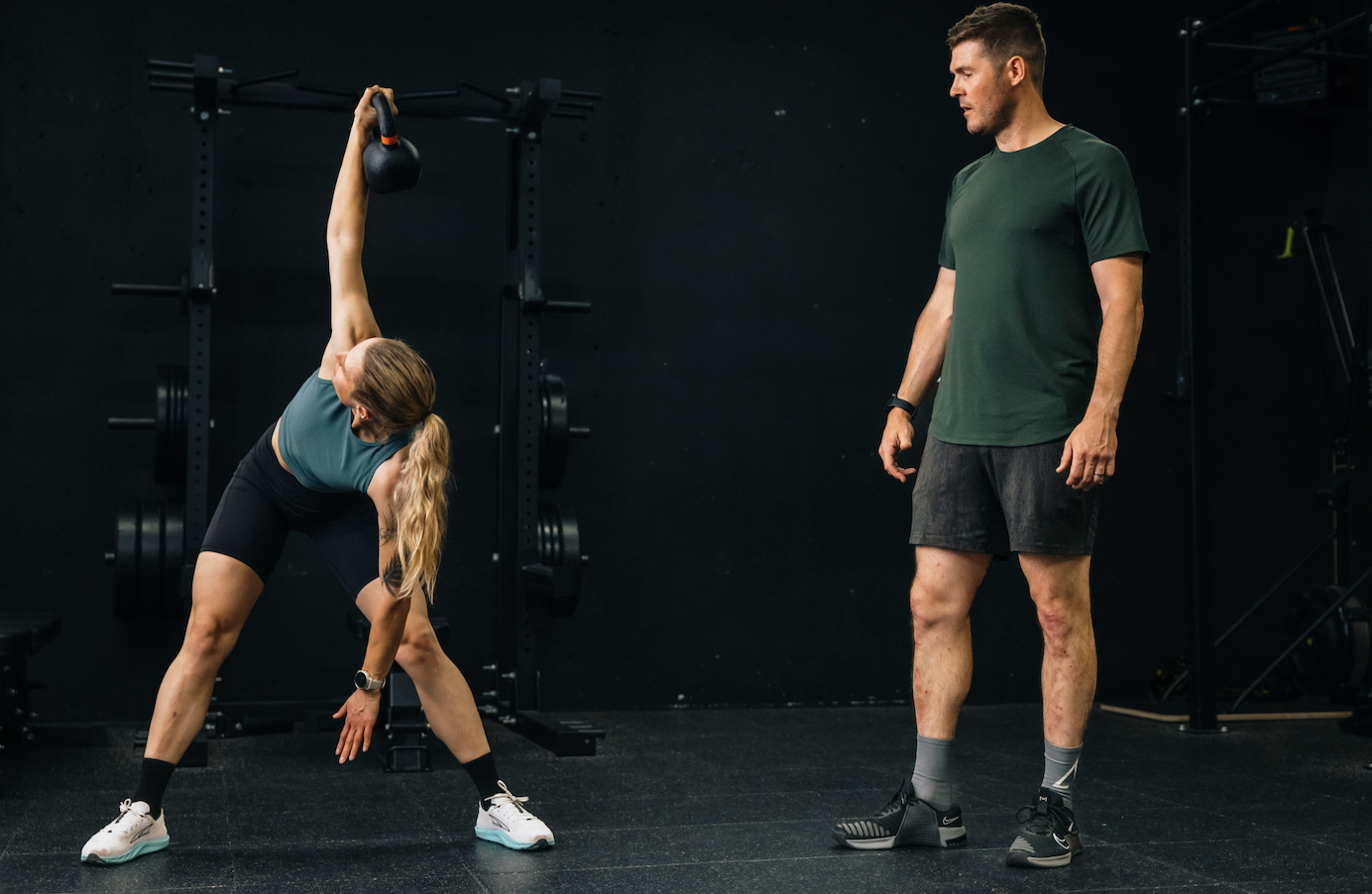
The chainsaw row maintains upper-back strength while also challenging trunk control and the rider’s ability to create a stable position.
Upper-back strength matters during braking, rough descents and longer periods in an aggressive riding position.
It can also help riders tolerate repeated forces through the arms and shoulders without collapsing through the upper body.
The movement should remain controlled.
Use a stable stance, keep the trunk organized and pull through the upper back rather than twisting or heaving the weight upward.
During heavy riding weeks, a few strong sets are more useful than turning the exercise into a high-repetition fatigue test.
Scapular Tripod
The scapular tripod develops shoulder-blade control while the rider supports force through the arms.
It provides a useful bridge between basic shoulder work and the demands of braking, absorbing trail forces and controlling the bike through rough terrain.
The focus should be on maintaining a strong trunk position while allowing controlled movement around the shoulder blade.
It should feel precise and coordinated rather than exhausting.
This type of low-cost shoulder work can be especially valuable during peak riding season, when the upper body is accumulating plenty of riding stress but receiving less structured strength training.
[Insert scapular tripod video]
Joint Health and Tissue Tolerance Still Matter
As the season progresses, riders often:
Ride longer.
Descend faster.
Attempt larger features.
Accumulate more vertical.
Race more frequently.
Spend more consecutive days on the bike.
Make more aggressive saves and corrections.
Their riding demands are increasing, even if their gym training is disappearing. This can create a mismatch. Your cardiovascular system may be ready for another lap while your calves, shoulders, back, or knees are becoming progressively less prepared for impact and unexpected forces.
That is why small doses of single-leg strength, lower-leg loading, upper-body pulling, trunk control, and movement variability remain useful. Joints generally do not become more resilient because we avoid loading them all summer. They become more resilient through appropriate exposure to load, range, and movement without overwhelming them.
Don't Let Your Engine Break Down
You wouldn’t spend $10,000 on a new bike and then neglect to maintain it. Your body is the engine that powers that bike, and it deserves the same attention. Neglecting your strength and mobility work during peak season is a surefire way to invite injury, reduce performance, and cut your riding season short. A smart, dialed-in in-season gym program isn't about crushing yourself; it's about intelligent maintenance. It’s about ensuring you can keep riding strong, prevent those nagging aches, and truly enjoy the trails you've worked so hard to conquer.
Ready to keep your body running as smoothly as your bike? Check out our in-season training programs designed specifically for mountain bikers.